


Wholesale buying is no longer happening over phone calls and spreadsheets. According to recent market research by Statista, global B2B ecommerce sales are projected to surpass $20 trillion in the coming years, reflecting steady double-digit growth across industries.
Businesses require advanced enterprise ecommerce web development solutions because their transaction volume and complexity exceed the capabilities of basic online catalogs. B2B platforms now include pricing engines, bulk ordering systems, ERP connections, and role-based dashboards as standard features. Businesses now consider these capabilities as mandatory requirements.
We believe that investing in B2B ecommerce web development services is the key to scalable growth and a competitive edge in today’s digital marketplace. – Mubashir Faiz, CEO at Diginautical
Strategic ecommerce web development services for businesses deliver measurable returns. Companies adopting optimized B2B ecommerce platforms report faster order processing, reduced operational costs, and improved average order values due to personalized pricing and automated workflows. For decision-makers, investing in the right digital infrastructure is no longer about keeping up with competitors.
Read More: ECommerce App Development Cost Your Complete Guide
What is B2B Ecommerce Website Development?

B2B ecommerce website development refers to the design and implementation of digital platforms that enable businesses to sell products or services directly to other businesses. Unlike consumer-focused platforms, B2B ecommerce solutions & services are built to manage complex transactions, negotiated pricing, bulk orders, and long-term contractual relationships. These systems are structured around multi-user accounts, approval hierarchies, credit terms, and recurring procurement workflows, which are rarely required in B2C environments.
To support scalability and flexibility, companies often invest in custom ecommerce system development tailored to their unique pricing structures, product catalogs, and backend systems. Businesses can build a single digital infrastructure that cuts down on manual work, improves accuracy, and strengthens long-term business relationships when they use enterprise ecommerce integration services like ERP development, CRM, and payment gateway connections.
Read More: Why Is Full Stack Web Development Essential for Business Growth
Core Features of a Successful B2B Ecommerce Website
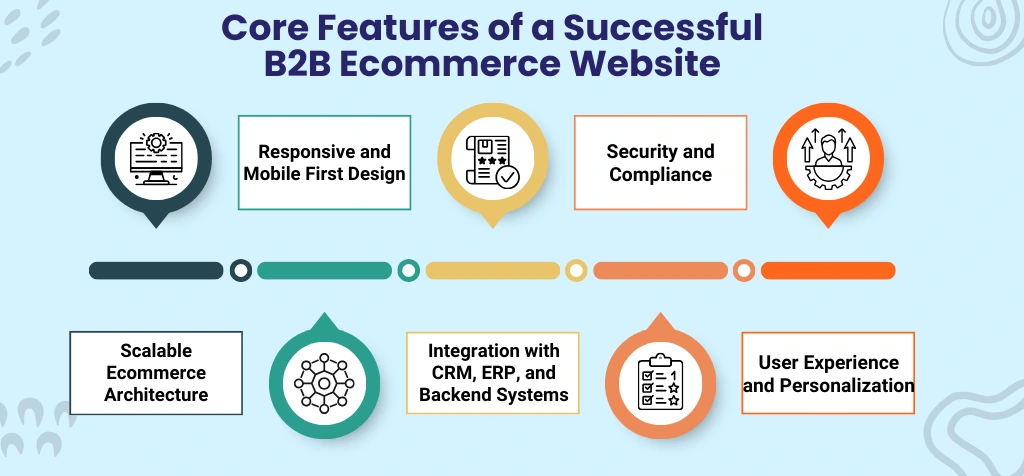
The following core features define platforms that scale efficiently and drive measurable business growth.
Scalable Ecommerce Architecture
A strong, scalable ecommerce architecture lets businesses handle a lot of transactions without slowing down. Enterprise buyers can be sure of accurate pricing, contract-based discounts, and smooth processing thanks to advanced bulk order management systems and a flexible tiered/B2B pricing engine.
Responsive and Mobile-First Design
Modern buyers expect access across devices, making mobile-first ecommerce development essential. Responsive ecommerce web design ensures consistent functionality on desktops and smartphones, while PWA ecommerce solutions enhance speed, offline access, and user engagement for corporate customers.
Integration with CRM, ERP, and Backend Systems
Seamless ecommerce CRM/ERP integration connects sales, finance, and inventory operations in real time. Ecommerce API & backend integration further enhance automation, while custom web development services ensure workflows align perfectly with existing enterprise systems and business processes.
Security and Compliance
Trust is critical in B2B transactions. Strong ecommerce security & PCI compliance protect sensitive financial data and contractual information. Continuous performance optimization for ecommerce, along with monitoring and threat detection systems, safeguards platform stability and operational continuity.
User Experience and Personalization
Effective UI/UX design for ecommerce portals simplifies complex purchasing journeys. With B2B ecommerce personalization & AI experiences, businesses can offer customized pricing, smart product recommendations, and tailored dashboards that improve buyer satisfaction and increase repeat transactions.
Read More: How to Make an eCommerce Mobile App for Android or iOS
Best Practices for B2B Ecommerce Web Development in 2026
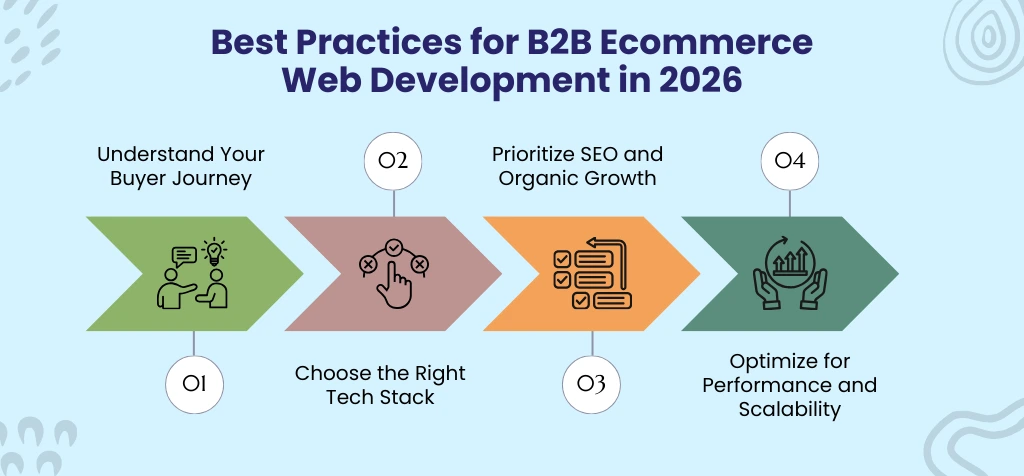
In 2026, starting a digital storefront is not enough to follow the best practices for B2B ecommerce web development services. It needs strategic planning, infrastructure that can grow with the business, and optimization based on data that is in line with changing customer needs and business needs.
Understand Your Buyer Journey
Mapping procurement workflows, approval hierarchies, and repeat purchasing behavior is essential when designing B2B ecommerce solutions & services. An optimized corporate ecommerce checkout should simplify bulk ordering, contract pricing validation, and multi-level approvals while reducing friction across departments.
Choose the Right Tech Stack
Selecting between monolithic and headless ecommerce development architectures directly impacts flexibility and scalability. Many enterprises prefer modular systems supported by an experienced ecommerce software development company, ensuring seamless enterprise ecommerce web development aligned with inventory integrations.
Prioritize SEO and Organic Growth
Sustainable growth depends on strong ecommerce SEO & organic traffic services that attract high-intent buyers. Combining technical optimization with targeted content marketing for B2B ecommerce and professional SEO services improves visibility, authority, and qualified lead generation across competitive markets.
Optimize for Performance and Scalability
Applying advanced performance optimization for ecommerce techniques, alongside mobile-first ecommerce development, ensures consistent experiences across devices. Integrating complementary mobile app development services further enhances accessibility and long-term scalability.
Read More: How to Use AI in Web Development? A Step-by-Step Guide for Beginners
Common Challenges in B2B Ecommerce Development
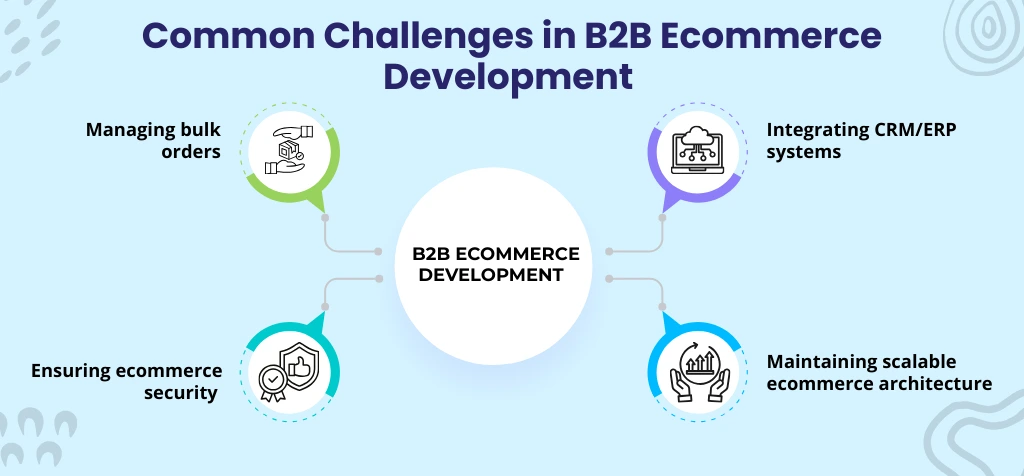
Even the most advanced B2B ecommerce web development services must navigate structural and operational complexities that do not exist in traditional online stores.
Managing Bulk Orders and Complex Pricing Structures
A business needs a strong tiered or B2B pricing system that can handle contract rates, customer discounts, and minimum order requirements to manage its high-volume transactions. The absence of accurate pricing automation leads businesses to face three major problems, which include customer billing mistakes, reduction of profit margins, and decreased business efficiency.
Integrating CRM and ERP Systems Seamlessly
B2B platforms must connect with accounting, inventory, and customer management systems in real time. Custom APIs and custom software development services are often required to synchronize orders, stock levels, and customer data without disrupting internal workflows.
Ensuring Ecommerce Security & Regulatory Compliance
Protecting sensitive financial and business information is critical. Strong encryption, secure payment gateways, and adherence to ecommerce security & PCI compliance standards help prevent breaches while building trust with enterprise buyers handling large transactions.
Maintaining Scalable Ecommerce Architecture for Growth
Platforms need to implement scalable ecommerce architecture because their order volumes and product catalogs continue to grow. The combination of infrastructure planning and cloud optimization, together with modular system design, creates a framework that enables organizations to maintain their operational efficiency for many years.
Tips for a Successful B2B Ecommerce Website

Businesses that want to stay competitive in complicated business environments must focus on long-term usability and continuous optimization when they hire custom software developers.
Choosing the right technical partner is equally important. Reliable custom software development services ensure smooth system integrations, secure payment processing, and flexible backend architecture. From ERP connectivity to CRM synchronization, seamless integration strengthens operational efficiency and data accuracy across departments.
To maintain consistent performance, companies should prioritize ongoing ecommerce web maintenance & support strategies, including:
- Routine performance monitoring
- Security audits and vulnerability checks
- System updates and version upgrades
- Backup management and disaster recovery planning
Why Choose Diginautical for B2B Ecommerce Web Development
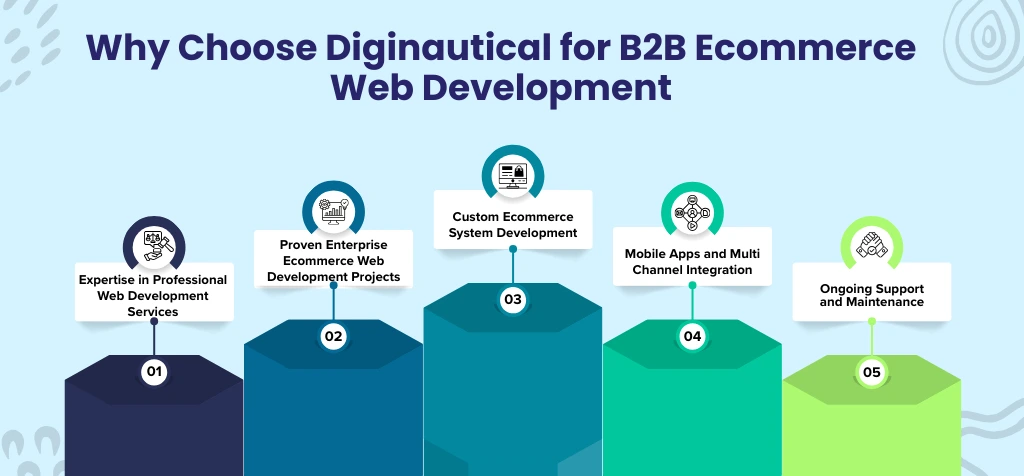
Selecting the right technology partner determines how effectively your digital commerce ecosystem performs, scales, and evolves with market demands.
Expertise in Professional Web Development Services
Diginautical delivers professional web portal development services tailored to complex B2B environments. Our expertise in ecommerce web development for businesses ensures secure architectures, optimized performance, and seamless digital experiences designed to support high-volume enterprise transactions.
- Strategic architecture planning
- Performance-driven development approach
- Security-focused implementation standards
Proven Enterprise Ecommerce Web Development Projects
Our portfolio reflects successful enterprise ecommerce web development initiatives across multiple industries. We design platforms that streamline procurement workflows, automate pricing structures, and integrate seamlessly with enterprise systems to improve operational efficiency.
- Large-scale B2B platform delivery
- ERP and CRM connectivity
- Scalable infrastructure deployment
Custom Ecommerce System Development
We create custom ecommerce systems that fit with your unique business model, complicated pricing structures, and approval hierarchies. This makes sure that they are flexible and can grow over time.
- Tailored backend frameworks
- Custom pricing and catalog management
- Modular feature development
Mobile Apps and Multi-Channel Integration
We extend digital commerce beyond web platforms by building mobile applications and integrating multi-channel systems, ensuring consistent performance across devices and business touchpoints.
- Native and cross-platform apps
- API-based integrations
- Unified customer data systems
Ongoing Support and Maintenance
Businesses can hire web developers for eCommerce to keep their systems running smoothly, make updates, and keep an eye on them all the time to make sure they stay safe and perform well over time.
- Continuous monitoring and upgrades
- Security audits and compliance checks
- Dedicated technical support team
Read More: Why Businesses Choose Diginautical’s Web Development Solutions to Launch Faster
Future Trends in B2B Ecommerce Development
As digital procurement keeps changing, smart businesses are putting money into technologies that make their ecommerce ecosystems more efficient, smart, and flexible.
AI-Driven Personalization
Modern platforms are leveraging B2B ecommerce personalization & AI experiences to deliver account-specific catalogs, predictive reordering, and dynamic pricing. With the support of advanced AI web development services, businesses can automate recommendations and enhance buyer engagement at scale.
Mobile-First Design and Progressive Web Apps
Enterprise buyers increasingly place orders via smartphones and tablets, making mobile-first strategies essential. Progressive Web Apps improve speed, accessibility, and offline functionality, ensuring seamless purchasing experiences across devices and distributed procurement teams.
Headless and Composable Commerce Architectures
Businesses are moving toward headless ecommerce development to keep the front-end and back-end systems separate. This modular method makes things more flexible, speeds up updates, and lets businesses add new technologies without having to rebuild their core infrastructure.
Advanced Analytics and Behavioral Insights
Making decisions based on data is now what gives you a competitive edge. Businesses can improve conversion rates, optimize product visibility, and refine pricing strategies by using real-time dashboards and advanced analytics tools to track user behavior in real time.
Read More: Top 10 Web Development Companies in the USA
Final Thoughts
Investing in B2B ecommerce web development services is no longer a strategic advantage reserved for large enterprises. It has become a foundational requirement for businesses aiming to streamline procurement, strengthen client relationships, and accelerate revenue growth.
If your business is ready to modernize its commerce ecosystem, partner with Diginautical for reliable and future-ready professional web development services designed to support sustainable growth and long-term performance.
Frequently Asked Questions
B2B platforms handle bulk orders, custom pricing, and multi-user accounts, unlike B2C sites built for individual consumers.
Depending on complexity, integrations, and customization, most projects take 4–8 months from planning to launch.
Absolutely. Modern enterprise ecommerce web development includes seamless ERP/CRM integration for real-time data and smoother workflows.
Yes. It allows flexible front-end experiences while keeping a scalable, robust backend for complex business operations.
Ongoing ecommerce web maintenance & support ensures security, performance, and feature updates, keeping your platform competitive and reliable.


