


Ecommerce is no longer just about putting products online and waiting for clicks. Almost 80% of leading e-commerce companies already use AI-powered solutions for personalization, dynamic pricing, and logistics optimization, and this adoption is expected to rise past 90% by 2026, making intelligent commerce the new norm instead of the exception.
At the center of this shift is artificial intelligence in ecommerce, quietly powering everything from personalized product discovery to automated operations and predictive management. Data, algorithms, and continuous learning now power what once needed manual analysis and speculation. This development reflects a more general AI-driven corporate change in which speed and accuracy define competitive edge.
This guide will cover how artificial intelligence helps increase sales, enhance ROI, and how companies expand when they effectively utilize it. Understanding artificial intelligence integration and its application in ecommerce is crucial for survival, whether you are a small store or a large corporation.
What Artificial Intelligence Means for Modern Ecommerce
Gone are the days when simple “if-this-then-that” automation known as rule-based systems could control operational complexity or customer expectations. The use of modern AI in ecommerce encompasses learning systems, predictive analytics, and automation, thus leading to the making of smarter, faster decisions throughout the business.
Here’s how ecommerce artificial intelligence is transforming online retail:
- Personalized Shopping Experiences: AI examines browsing and purchase history to provide AI-powered ecommerce solutions, including tailored product recommendations, dynamic pricing, and personalized promotions.
- Smart Inventory Management: AI predicts demand, optimizes stock levels, and reduces waste by learning patterns from historical sales and seasonal trends.
- Automated Customer Support: Powered by AI chatbots and virtual assistants may manage questions around-the-clock, hence lowering response times and increasing customer satisfaction.
- Fraud Detection and Security: Real-time transaction monitoring by machine learning algorithms helps to spot anomalies before they develop into serious problems.
- Data-Driven Decision Making: AI allows insights from huge datasets, thus giving companies the power to make faster, evidence-based operational and marketing decisions.
Artificial intelligence turns complex data into simple business decisions.- Mubashir Faiz, CEO at Diginautical.
Key AI Applications Transforming Ecommerce Today
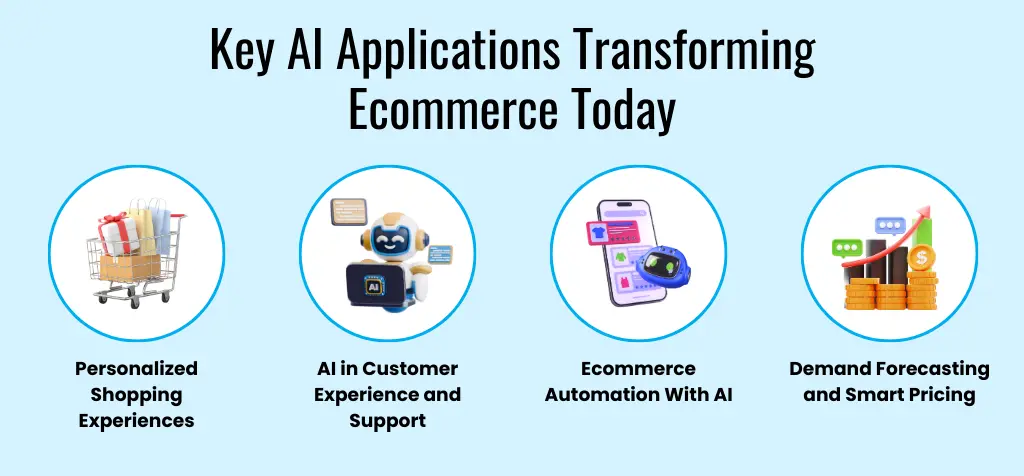
1. Personalized Shopping Experiences at Scale
Once a luxury, personalization is now taken for granted. AI-powered personalized shopping lets companies monitor purchase history, browsing patterns, and even engagement to provide very relevant product suggestions. Recommendation engines constantly evaluate this information to suggest goods that clients would be most likely to buy.
- Recommendation engines: Analyze browsing, purchase history, and engagement to suggest products customers are likely to buy.
- Higher engagement: Personalized suggestions keep shoppers on-site longer.
- Repeat purchases: Tailored experiences increase customer loyalty and average order value.
- Scalable personalization: AI-driven product recommendations allow even large catalogs to feel curated for each shopper.
2. AI in Customer Experience and Support
Speed and support uniformity are needed in modern ecommerce. Artificial intelligence in customer experience guarantees timely resolution of customer questions by powering chatbots, virtual assistants, and smart ticket routing.
Companies adding AI-powered ecommerce tools in their support systems claim increased consumer happiness and reduced operational expenses without sacrificing human touch for difficult situations.
3. Ecommerce Automation With AI
Ecommerce automation using artificial intelligence simplifies processes and lowers mistakes from order fulfillment through inventory management. AI technologies free teams to concentrate on strategic projects by monitoring stock levels, automating reordering, and efficiently managing order processing.
- Inventory management: Monitors stock levels and triggers automatic reorders.
- Order processing: Reduces manual errors and speeds up fulfillment.
- Fraud detection: Identifies suspicious activity before it affects revenue.
- Operational efficiency: AI for online retail enables teams to focus on strategic growth while daily tasks run smoothly.
4. Demand Forecasting and Smart Pricing
Profitable e-commerce depends on precise demand forecasting. AI for demand prediction uses past sales, seasonal trends, and market indicators to forecast product need. This knowledge helps companies to maximize inventory, reduce stockouts, and lower overstock expenses. Using these tools, merchants may maximize revenue while keeping consumers happy with competitive prices.
Read More: ECommerce App Development Cost – Your Complete Guide
Benefits of AI in Ecommerce for Businesses
1. Higher Conversions
AI changes how consumers engage with online businesses. Businesses can provide very customized suggestions and promotions by examining browsing habits, purchase history, and engagement data. This level of precision increases the likelihood of purchase, turning casual visitors into buyers.
AI can improve product placements, promotional timing, and checkout experiences using smart commerce solutions as well. Modern ecommerce software development companies frequently use these technologies to lessen friction and enable frictionless purchasing. The result is more average order values, a measurable rise in conversion rates, and a generally better bottom line.
2. Better Customer Retention
Keeping customers engaged is as important as acquiring new ones. Intelligent digital commerce powered by AI helps brands maintain ongoing relationships by offering personalized experiences, timely promotions, and proactive customer support.
AI tracks behavior and forecasts preferences, therefore helping businesses to deliver appropriate product recommendations or reminders at the optimum time. First-time customers become long-term advocates for your company over time as these relationships create loyalty and repeat purchases.
3. Lower Operational Costs
Automation through AI reduces manual effort in inventory management, order processing, and customer support. Businesses can streamline workflows while minimizing errors and overhead.
Businesses free up human resources for strategic efforts by using AI-powered solutions to manage everyday chores. This efficiency guarantees that resources are employed where they produce the greatest value by lowering operating expenses while keeping high service levels.
4. Smarter Decision-Making
AI helps leaders to swiftly and confidently make data-driven decisions by offering practical insights from huge datasets. From product creation to sales forecasting, these ideas direct every part of online commerce.
Smart commerce solutions from a reputable ecommerce software development company enable predictive analytics and trend analysis, ensuring that strategies are proactive rather than reactive. Businesses can respond faster to market changes, optimize pricing, and anticipate customer demand, resulting in a sustainable competitive advantage.
Read More: How to Create Artificial Intelligence A Complete Guide
Challenges Businesses Face When Implementing AI in Ecommerce
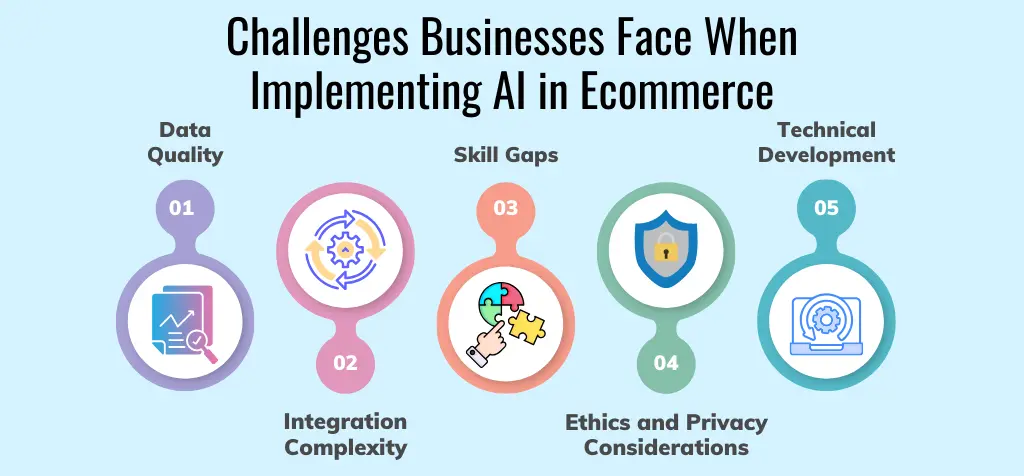
Implementing AI in ecommerce can deliver huge benefits, but it’s not without hurdles. Businesses must navigate technical, operational, and ethical challenges to ensure successful adoption. Dealing with these early on maximizes return on investment and prevents expensive setbacks.
Data Quality
AI systems rely on clean, accurate, and comprehensive datasets. Poor or inconsistent data can lead to incorrect predictions, flawed recommendations, and suboptimal decision-making.
Integration Complexity
Technically difficult is the integration of artificial intelligence with current CRM, ERP, and ecommerce systems. Often necessary to guarantee seamless, scalable deployment are artificial intelligence integration services.
Skill Gaps
Developing, maintaining, and interpreting AI solutions requires specialized expertise in machine learning, data science, and analytics. Many teams struggle to bridge this gap internally.
Ethics and Privacy Considerations
Handling customer data properly is vital; hence, certain considerations. Compliance with privacy laws, transparent AI usage, and ethical decision-making are essential to maintain trust.
Technical Development
Building artificial intelligence models and tools calls for strong AI software development procedures to guarantee dependability, security, and future scalability.
The Future of Ecommerce With Artificial Intelligence
By 2026–2030, the future of ecommerce with AI will be shaped by:
- Hyper-personalization provides customized suggestions, discounts, and material depending on real-time conduct.
- Voice and image commerce let customers find and buy using verbal instructions or pictures.
- Predictive customer journeys are guided smoothly from discovery to purchase via artificial intelligence, anticipating user needs.
- Applications of artificial intelligence unique to particular industries let companies like those in real estate and fashion use AI customized to their activities and clientele.
Mini Case: A mid-sized fashion retailer used industry-specific AI applications and visual search to increase conversion rates by 28% in just four months, demonstrating the tangible impact of AI-powered digital commerce.
Conclusion: Smarter Commerce Is Built, Not Bought
Artificial intelligence has become an essential component of ecommerce. It’s required if you want to stay competitive. It improves ROI, reduces expenses, and encourages repeat purchases, resulting in increased sales. Stores feel sluggish, unremarkable, and forgettable without artificial intelligence.
As your business grows, incorporate tailored artificial intelligence solutions from a trusted partner, such as Diginautical, predictive analytics, hyper-personalization, and sector-specific AI applications that significantly improve the shopping experience.
Frequently Asked Questions
AI can impact personalization, recommendations, and inventory management within weeks if implemented strategically.
Not necessarily, but AI adapts and improves over time, and even mid-sized stores can see gains with smart data use.
Yes, predictive analytics and machine learning enable AI to anticipate customer behavior, inventory needs, and sales spikes.
No. Small and mid-sized businesses can use custom AI solutions to compete with larger players efficiently.
Track KPIs like conversion rates, cart abandonment, repeat purchases, and customer engagement to see tangible ROI.


