

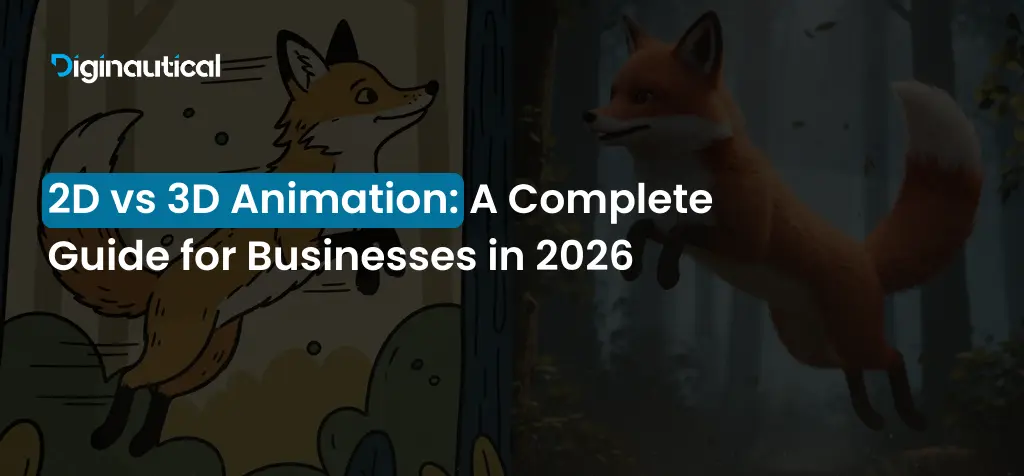
A single visual can now do what long presentations once struggled to achieve. According to one report, the animation market is predicted to grow exponentially in revenue to USD 895.71 billion by 2034. The real question many brands face today is not whether to use animation, but which approach delivers the most impact.
The choice between 2D vs 3D animation shapes how a message is perceived. Flat, illustrative visuals excel at breaking down ideas quickly, while depth-driven animation brings products, environments, and processes closer to real life. This flexibility has made animated corporate videos a go-to format across industries, from SaaS and e-commerce to healthcare and real estate.
In this guide, you’ll explore what sets 2D and 3D animation apart, the goals each style supports, their practical advantages and limitations, and the key factors that will help you choose the right animation approach for your brand.
Read More: A Beginners Guide to 3D Character Animation
What is 2D Animation?

2D animation is a visual storytelling technique where characters, objects, and scenes are created and animated in a two-dimensional space. It relies on illustrations, shapes, and motion rather than depth, making it ideal for conveying ideas quickly and clearly. A professional 2D animation studio focuses on clean design, smooth transitions, and purposeful motion to keep the audience engaged while reinforcing brand identity.
Many brands choose to hire 2D animators because this format adapts easily to marketing campaigns, internal communications, and digital platforms. Its flexibility allows companies to maintain consistency across videos while delivering information in a visually appealing way.
Common business applications include:
- Explaining products, services, or workflows in a clear and engaging format
- Supporting training and onboarding initiatives with easy-to-follow visuals
- Enhancing brand storytelling through expressive characters and illustrations
- Creating adaptable content for websites, presentations, and social channels
What is 3D Animation?

3D animation is a visual technique that brings objects, characters, and environments to life with depth, dimension, and realism. Unlike flat visuals, it allows brands to present products and ideas from every angle, making complex concepts easier to understand and far more engaging. From detailed 3D product animation to expressive 3D character animation, this style adds credibility and visual impact to corporate communication.
Many organizations choose to hire 3D character animators when projects require nuanced motion, emotional expression, or technically accurate visuals. This approach is especially effective for industries like healthcare, automotive, real estate, and ecommerce, where visual accuracy influences trust and decision-making.
Key strengths of 3D animation include:
- Ability to visualize products and environments before they exist
- Strong impact for demonstrations, simulations, and walkthroughs
- High engagement through realistic motion and lighting
- Greater flexibility for long-term reuse across marketing and training materials
Key Differences Between 2D vs 3D Animation

Understanding the practical differences between 2D vs 3D animation helps businesses choose the right visual approach for communication, marketing, and product storytelling. Below is a clear breakdown to make decision-making easier.
| Aspect | 2D Animation | 3D Animation |
|---|---|---|
| Visual Style | Flat, illustrative, concept-driven visuals | Depth-based, realistic, immersive visuals |
| Production Workflow | Simpler process with faster turnaround | Multi-stage pipeline with modeling, rigging, and rendering |
| Cost Range | More budget-friendly | Higher investment due to complexity |
| Audience Impact | Strong for clarity and storytelling | Strong for realism and engagement |
| Best Use Cases | Explainers, training, internal comms | Product demos, simulations, walkthroughs |
| Industry Fit | SaaS, education, marketing | Healthcare, automotive, real estate |
| Scalability | Easy updates and revisions | Long-term reuse across platforms |
Visual Style Comparison
2D animation focuses on clean, illustrative visuals that guide viewers through ideas without distraction. In comparison, 3D animation creates a sense of depth and realism, making it ideal for animated product demo videos that require visual precision.
Production Workflow
The 2D workflow is more straightforward, enabling quicker delivery and easier revisions. 3D animation follows a layered production process that supports advanced visuals and is commonly used in professional 3D animation services for business.
Audience Engagement
2D animation keeps viewers engaged by simplifying information and maintaining narrative flow. 3D animation increases engagement by allowing audiences to explore products and environments visually, which enhances understanding and recall.
Technical Requirements
2D animation requires lighter tools and smaller teams, making it accessible for many businesses. 3D animation involves advanced software, stronger hardware, and specialized skills, especially for teams working with 3D character animation for beginners transitioning to enterprise projects.
Industry Applications
2D animation is widely used for training, onboarding, and brand communication. 3D animation supports industries that rely on spatial accuracy and detail, such as healthcare, manufacturing, and 3D architecture animation.
Animation Flexibility
2D animation adapts easily across multiple formats, including presentations and social media. 3D animation offers deeper flexibility for interactive content, long-term visualization, and immersive brand experiences.
Read More: Choosing the Best 3D Animation Company – A Complete Guide
Pros and Cons of 2D and 3D Animation Services

When deciding between 2D vs 3D animation, understanding the benefits and limitations of each approach is essential for effective business communication and product visualization. Both styles are widely used in animated corporate videos, but they serve different purposes depending on the industry and project goals.
2D Animation Pros
Partnering with a 2D animation company or 2D animation studio like Diginautical and Animakerz allows businesses to create visually appealing content without the complexity of three-dimensional modeling. 2D animation works particularly well for explainer animations for e-commerce platforms, SaaS onboarding, and employee training videos, where clarity and engagement are key.
Advantages of 2D animation include:
- Cost-effective production for marketing, internal communications, and training videos
- Faster turnaround due to a simpler production workflow
- Clear, focused storytelling that simplifies complex ideas
2D Animation Cons
While 2D animation excels in simplicity, it can fall short when visual depth or realism is required. This limitation becomes more noticeable in complex or highly technical projects.
Common limitations include:
- Limited realism, as flat visuals lack depth and physical accuracy.
- Reduced impact for complex products, especially those requiring spatial visualization.
- Minimal interactivity, making it less effective for simulations or walkthrough-style content.
3D Animation Pros
3D animation brings products, characters, and environments to life with depth, perspective, and realistic motion. Businesses often engage a 3D animation company or hire 3D character animators to produce content that enhances visual storytelling and elevates brand presence.
Advantages of 3D animation include:
- Immersive visuals that capture viewer attention and boost engagement
- Highly effective for product demos, architectural walkthroughs, and technical explanations
- Flexibility across industries such as healthcare, automotive, real estate, and e-commerce
3D Animation Cons
While 3D animation provides realism and versatility, it comes with higher costs and more complex production requirements. Organizations must consider timelines, budgets, and technical resources before choosing this approach.
Limitations of 3D animation include:
- Higher production costs due to specialized software and skilled animators
- Longer timelines, as modeling, rigging, and rendering require more effort
- Technical complexity, demanding powerful hardware and experienced teams
The power of animation lies in clarity and creativity, and the right style makes every story unforgettable. – Mubashir Faiz, CEO at Diginautical
Cost Factors to Consider in 2D vs 3D Animation

When evaluating 2D vs 3D animation cost & timeline, businesses must consider project complexity, talent, and industry needs to ensure the best ROI from corporate animation services and video campaigns.
- Project Complexity: Longer videos, multiple scenes, and intricate animation styles increase production costs. 3D projects generally require more planning, modeling, and rendering than 2D, impacting both time and budget.
- Talent Requirements: Hiring 2D animators, character specialists, or motion graphics artists affects costs. Complex 3D character animation typically demands higher expertise compared to basic 2D or whiteboard animation services for beginners.
- Software & Tools: 3D animation requires advanced platforms and powerful hardware, while 2D workflows can run on lighter software. Investment in tools affects total project cost and production flexibility.
- Production Timeline: Because of their easier processes, 2D animation usually has a faster turnaround. Modelling, rigging, and rendering in 3D animation extend timelines and raise corporate content costs for sophisticated features.
- Industry-Specific Costs: Healthcare, SaaS, e-commerce, and real estate projects vary in complexity. Highly technical visuals or accurate product demos increase 3D animation costs compared to simpler 2D storytelling.
- ROI Potential: Animation investment pays off by improving engagement, conversions, and brand recall. Well-produced 2D or 3D content enhances marketing, training, and product demo outcomes, delivering measurable business impact.
2D vs 3D Animation Trends to Watch in 2026

Staying ahead in visual communication means embracing the latest animation trends for brands in 2026.
Hybrid Animation Styles
Combining 2D and 3D techniques gives a lot of possibilities, letting the brands fuse the clear image with the emotional visuals. This method is particularly suitable for explainer videos and whiteboard animation projects that require both style and depth.
Interactive Motion Graphics
Animations with clickable or interactive elements increase engagement, making content more memorable. Businesses use interactive visuals for training courses, dashboards, and product demonstrations to increase viewer involvement.
Character-Driven Stories
Characters bring personality and relatability to storytelling. Character animation is increasingly used to communicate brand values, create memorable narratives, and humanize messages.
Simple Design Trends
Clean, modern visuals dominate architecture and explainer videos. Minimalistic design improves audience focus and readability, therefore making two-dimensional animation more successful for clear communication free from distraction.
Realistic Product Visuals
3D product animation continues to be essential for the automotive, ecommerce, and tech industries. Realistic renderings help customers visualize products, understand features, and drive informed decisions.
Immersive 3D Experiences
AR/VR-inspired 3D animations are transforming interactive marketing and corporate learning. These 3D animation services allow immersive walkthroughs, simulations, and 3D architectural animation, creating memorable experiences for viewers.
Why Choose Diginautical for Your Animation Needs

Diginautical is a leader in providing top-notch corporate animation services when it comes to 2D versus 3D animation. Our proficiency in both 2D and 3D animation guarantees that each project produces quantifiable outcomes while telling an engaging tale.
Award-Winning Animators
Our team of animators brings a wealth of experience in 2D, 3D, and hybrid formats. Working with a top 2D animation studio or 3D animation company, we transform ideas into visually compelling stories that resonate with viewers and elevate your brand.
Modern Technology
We use the latest animation tools and motion graphics platforms to produce highly detailed 3D product animation and smooth 2D sequences. This allows for realistic visuals, precise movements, and immersive experiences that hold attention and convey your story with clarity.
Tailored Industry Solutions
From healthcare software development and SaaS to e-commerce, automotive, and real estate, our animations are designed to meet the unique needs of each industry. Every project is customized to highlight your brand, simplify complex ideas, and create meaningful engagement.
Story-Driven Creativity
We focus on brand story animation services that bring your message to life. Whether it’s a 3D explainer video, animated corporate storytelling, or a product demo, we craft narratives that connect emotionally with your audience and leave a lasting impression.
Seamless Project Delivery
Diginautical ensures smooth project execution with efficient timelines, scalable workflows, and consistent quality. Our clients can rely on us to deliver polished 2D vs 3D animation content on schedule without compromising creativity or impact.
Interactive and Immersive Experiences
We combine the best of 2D and 3D techniques to create hybrid animations that are both interactive and visually immersive. These experiences make corporate communication, training modules, and product demos more engaging and memorable.
Proven Client Success
Clients see measurable ROI, increased engagement, and high satisfaction. By choosing Diginautical, you can confidently hire 2D animators or hire 3D animators knowing your animation project will deliver both impact and business value.
Which Animation Is the Best Option to Choose?
Choosing between 2D and 3D animation in corporate videos depends on your business goals, audience, and project requirements. 2D animation services are ideal for explainer videos, internal communications, and marketing campaigns that need clarity, simplicity, and faster delivery. They offer cost-effective solutions and are perfect when the focus is on storytelling, branding, or conveying concepts without requiring immersive realism.
On the other hand, 3D animation services excel when showcasing products, complex processes, or interactive experiences. They provide depth, realism, and flexibility, making them suitable for industries like healthcare, automotive, real estate, and e-commerce. By understanding your timeline, budget, and intended impact, businesses can select the right corporate animation services to maximize engagement, drive ROI, and deliver visually compelling content that aligns with their objectives.
Finally, choose 2D for speed, simplicity, and cost efficiency, and 3D when realism, engagement, and versatility are most important.

Final Thoughts
Understanding the difference between 2D and 3D animation styles is essential for businesses aiming to create impactful animated corporate videos. By weighing the pros and cons of each style, companies can select the approach that aligns with their audience, goals, and budget.
Partnering with a professional team ensures the highest quality results. Diginautical provides expert 2D and 3D animation services, including 3D character animation services, hybrid projects, and industry-specific solutions.
Frequently Asked Questions
Consider your audience, project goals, budget, and timeline. Choose 2D for simplicity and fast delivery, and 3D for realism, product demos, or immersive storytelling.
Yes, hybrid animation allows you to leverage the clarity of 2D with the depth and interactivity of 3D, creating engaging corporate videos for training, marketing, or product demos.
Generally, yes. 3D involves modeling, rigging, and rendering, but timelines vary depending on project complexity, scene length, and level of detail.
Sectors like healthcare, automotive, real estate, and e-commerce gain the most from 3D’s realism, immersive visuals, and product-focused storytelling.
High-quality 2D or 3D animation boosts engagement, simplifies complex ideas, enhances brand storytelling, and increases conversions across marketing, training, and product demo campaigns.