

Consider a world where software develops itself, flaws forecast their own fixes, and every corporate decision is supported by immediate insights. This is no longer sci-fi; AI in software development has moved from experimentation to a cornerstone of modern tech strategy. Today roughly 84% of developers intend to use or currently use AI tools to speed coding, automate testing, and streamline workflows.
This move to AI-driven software development improves speed, scalability, and decision-making beyond what has ever been seen before. While predictive insights enable teams to make better architectural and strategic decisions throughout the software development lifecycle, businesses claim major acceleration in delivery cycles and automation of daily activities.
However, today’s digital transformation indicates the process of smart AI development systems that conceptualize, adjust, and grow systems driven by core intelligence rather than advanced technology. The businesses that welcome this alteration at the outset are emerging as leaders in their respective categories. Let’s dig into the reasons behind this trend.
Read More: Top 15 AI Agent Development Companies
The Role of AI in Modern Software Development
Now imagine this, the software that predicts its own errors also suggests improvements, and adapts to user behavior even before launch. This is the reality of AI in software development, where AI is no longer a supporting tool but a driving force behind innovation.
Key ways AI-powered software development is transforming the modern SDLC:
- Smarter Planning & Requirements Analysis: AI tools analyze user data and project scope to forecast timelines, budget, and potential risks with high accuracy.
- Automated Development: From generating code snippets to performing intelligent code reviews, AI reduces repetitive work and accelerates delivery.
- Predictive Testing & Quality Assurance: AI-driven testing platforms identify bugs before they escalate and simulate user behavior for more reliable releases.
- AI + DevOps Integration: Automated deployment, monitoring, and incident prediction streamline continuous delivery pipelines.
- Enhanced Decision-Making: Predictive intelligence helps teams make data-driven choices on architecture, performance, and scalability.
Read More: How to Create Artificial Intelligence
Key Benefits of AI in Software Development
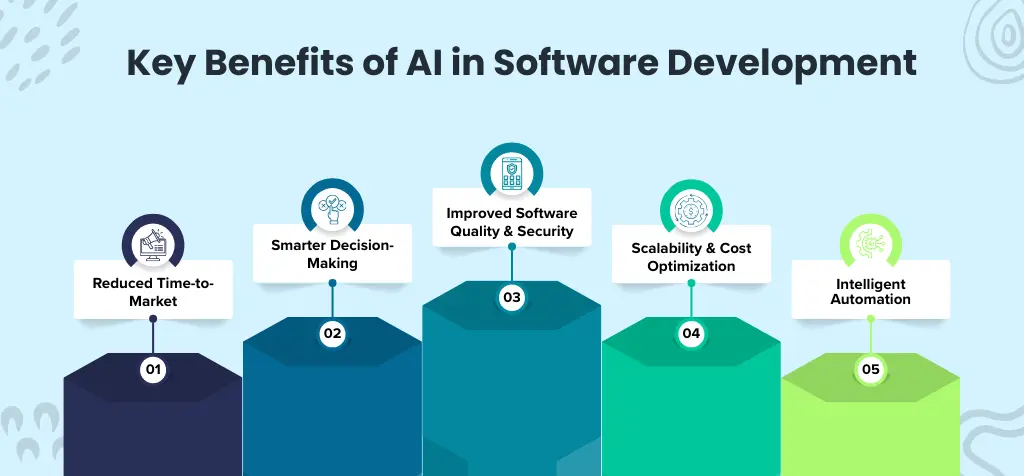
The use of AI in software development goes far beyond a trend; it provides tangible benefits that change how software is built, deployed, and scaled. Businesses that use AI-based software solutions can accelerate innovation while reducing operational risks.
Reduced Time-to-Market
The faster and more efficient software delivery is the result of AI-assisted coding, automated testing, and CI/CD pipeline automation cooperation. With the help of smart coding suggestion tools and AI-powered debugging, the amount of manual work is significantly reduced, allowing software engineers to brainstorm and carry out less valuable tasks.
Smarter Decision-Making With Predictive Intelligence
AI-based software solutions provide predictive insights across the development lifecycle. From forecasting project risks and system performance to analyzing user behavior, AI empowers decision-makers to proactively adjust strategies and guide CRM development for smarter customer management.
Improved Software Quality & Security
Automated QA and anomaly detection tools identify bugs, performance issues, and vulnerabilities earlier than traditional methods. AI-driven security systems continuously monitor applications for suspicious behavior, ensuring robust protection and higher software reliability.
Scalability & Cost Optimization
AI optimizes infrastructure usage, resource allocation, and load balancing for scalable applications. Businesses can plan capacity more effectively and reduce operational costs, enabling software solutions when you hire custom software developers to grow seamlessly with user demand.
Intelligent Automation
AI automation at every stage of the development process minimizes human involvement, hastens the completion of boring tasks, and boosts the overall efficiency of the workflow. This smart automation is the very foundation of AI in modern software development, enabling businesses to not only be quick but also to ensure the quality and control over the process.
Read More: Top Software Development Companies
What Businesses Need to Know About AI in Modern Software Development
Not every enterprise can rely on off-the-shelf software. Here’s why custom software application development services in USA paired with AI in software development are a game-changer:
- Tailored to Your Needs: Unlike templates, custom solutions fit unique workflows, integrations, and security requirements.
- Intelligent Capabilities: AI-powered automation, predictive analytics, and adaptive interfaces enhance platform efficiency.
- Smarter Decisions: AI-based software solutions provide insights, forecast trends, and optimize operations.
- Scalable & Future-Ready: Custom AI applications grow with your business, handling increased loads and evolving requirements.
- Competitive Advantage: Businesses gain faster innovation, better performance, and full control over digital assets.
How to Build an AI-Ready Software Development Strategy
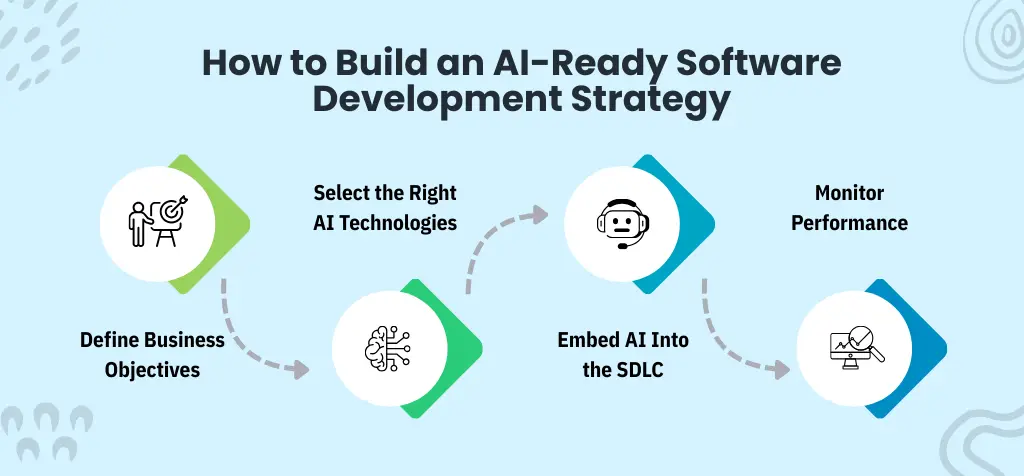
Developing a strong AI-powered software development strategy ensures that your company can use intelligence at all stages of the SDLC. Follow these four main steps:
Step 1: Define Business Objectives
Evaluate your objectives, processes, and available data. Ensuring clean, structured, and relevant data is crucial for B2B software and AI-based software solutions to deliver accurate insights.
Step 2: Select the Right AI Technologies
Select tools and frameworks that match your business needs, such as TensorFlow, PyTorch, AutoML, or AI SDKs. The right stack accelerates development while maintaining scalability.
Step 3: Integrate AI into SDLC
Embed AI into development, testing, and deployment workflows. Combining DevOps with MLOps ensures seamless collaboration between software and AI models.
Step 4: Monitor Performance
Continue to monitor AI outcomes, performance metrics, and user impact. Use insights to fine-tune algorithms and increase the efficacy of AI-powered software development.
Read More: How Much Does Custom Software Development Cost
Cost of AI in Software Development in 2026
Investing in AI-powered software is no longer an option for businesses looking to remain competitive. While the cost of AI software development in 2026 varies depending on complexity and scale, organizations should consider the potential ROI as well as pricing.
| AI Solution Type | Typical Cost Range (USD) | ROI / Value |
|---|---|---|
| Small AI Features (chatbots, automation) | $5,000 – $25,000 | Streamlines repetitive tasks, improves customer engagement, quick adoption. |
| Mid-Scale AI Apps (recommendation engines, analytics dashboards) | $25,000 – $100,000 | Data-driven insights, personalized user experiences, performance gains. |
| Enterprise AI Platforms (ERP, CRM, AI agents) | $100,000+ | Optimizes operations, predictive analytics, and long-term strategic advantage. |
What Factors Affect the Cost of AI in Custom Software Development?
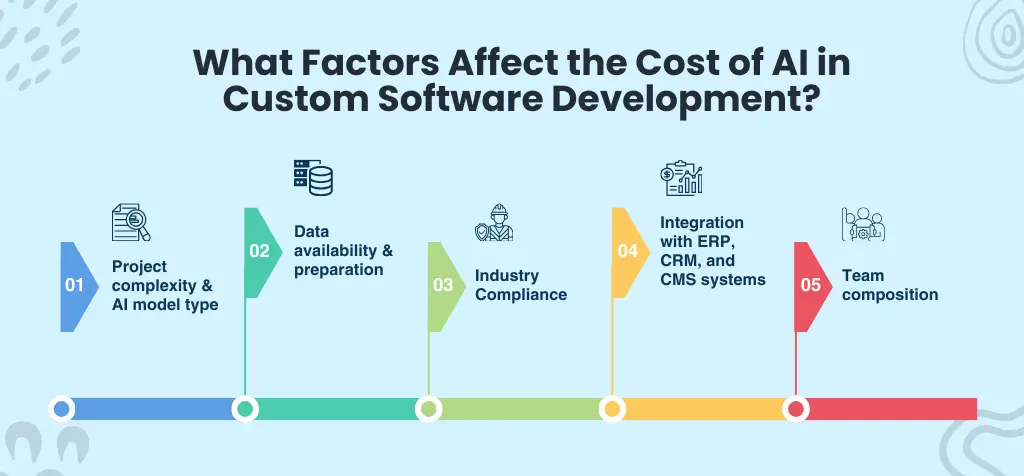
Understanding the cost of AI software development is essential for businesses planning intelligent software solutions. Several key factors influence pricing and ROI:
1. Project Complexity & AI Model Type
Development time and cost are directly affected by the complexity of your project and the kind of AI systems needed, including predictive analytics, NLP, or recommendation engines. Higher competence and resources are required by more complex artificial intelligence models.
2. Data Availability & Preparation
High-quality data is the backbone of AI-powered software development. Costs increase if data requires cleaning, structuring, or augmentation to train AI chatbots and generative AI models effectively.
3. Industry Compliance
Regulated industries like healthcare, finance, and logistics require compliance with standards (HIPAA, PCI, ISO). Meeting these adds to both time and cost.
4. Integration with ERP, CRM, and CMS Systems
Seamless integration with existing enterprise systems increases development complexity. AI-driven solutions that enhance ERP or CMS functionality require careful architecture and testing.
5. Team Composition
Deciding whether to hire AI app developers in-house or work with specialized agencies affects overall cost. Agencies may provide faster delivery and broader expertise, while in-house teams give long-term control and flexibility.
Read More: How AI Is Transforming E-Commerce
Why Choose Diginautical for AI Software Development?
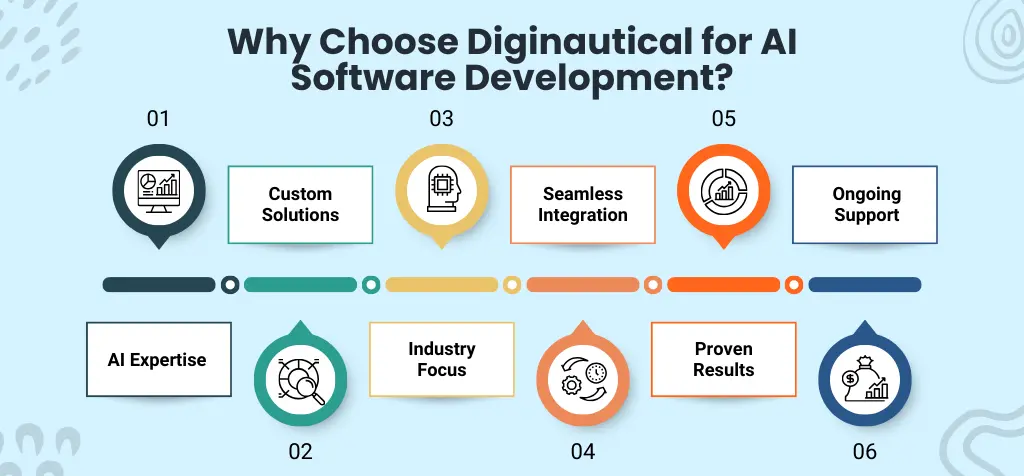
Diginautical stands out as a premier partner for businesses seeking AI web development and intelligent software solutions. Here’s why companies trust us:
- AI Expertise: Our team of skilled professionals brings deep experience in building AI-based software solutions, predictive analytics, and intelligent automation tools.
- Custom Solutions: We deliver tailored platforms that address unique business needs, ensuring scalable and future-ready applications.
- Industry Focus: Our solutions are designed to meet industry-specific challenges and compliance requirements.
- Seamless Integration: We integrate AI features into existing ERP, CRM, and CMS systems, enhancing workflows without disrupting operations.
- Proven Results: Our portfolio reflects successful AI projects that improve efficiency, user experience, and ROI for global clients.
- Ongoing Support: Diginautical provides continuous maintenance, optimization, and upgrades, allowing businesses to utilize AI capabilities long-term.
Whether you want to hire AI app developers or collaborate with leading AI agent development companies for intelligent solutions, Diginautical ensures high-quality AI implementation tailored to your enterprise goals.
Read More: Why Diginautical Is the Perfect Partner for Enterprise Software Development
The Future of AI in Software Development
The future of AI in software development points toward autonomous systems that streamline processes, reduce human error, and enhance efficiency. AI agents are increasingly replacing repetitive workflows, allowing teams to focus on strategic initiatives and innovation.
As businesses embrace AI in digital transformation, ethical and responsible AI adoption becomes critical, ensuring transparency, fairness, and compliance across applications.
Leading enterprises are working with top AI agent development companies to integrate intelligent agents, predictive automation, and adaptive platforms and create software that not only meets current needs but also evolves continuously to anticipate future demands.
Read More: What Is the Difference Between AI Chatbots and AI Agents
Final Thoughts
Adopting AI-driven software development strategically enables companies to stay ahead in digital transformation, optimize operations, and deliver superior user experiences across industries.
For enterprises looking to implement custom solutions, partnering with experts like Diginautical ensures seamless integration, AI-powered capabilities, and long-term support by transforming software into a true strategic asset.
Frequently Asked Questions
AI analyzes historical and real-time data to predict outcomes, optimize workflows, and suggest architecture or feature changes instantly.
Yes, bespoke AI platforms can adapt to healthcare, fintech, retail, and logistics, with tailored modules for each sector’s specific needs.
Unlike standard automation, AI systems learn, predict, and adapt over time, offering intelligence rather than just repetitive task execution.
AI agents monitor builds, detect anomalies, and trigger corrective actions automatically, reducing downtime and accelerating deployment cycles.
Responsible AI adoption ensures transparency, fairness, and compliance while maintaining high performance and business value in intelligent systems.