

Custom software development has become a strategic investment rather than a technical expense, as worldwide software spending is expected to reach $1.4 trillion by 2026. This increase in demand has also heightened attention on custom software development costs; hence, budget planning is now more important than it ever was.
Have you ever wondered why some digital initiatives remain within budget whereas others see expenses double before release? Estimating custom software pricing in 2026 is a corporate-critical choice that might define a project’s success or failure, not merely a rudimentary estimate. Early cost estimates often become blurred by shifting criteria, integration complexity, and changing technologies.
Building software is more than development; it’s about creating solutions that adapt and deliver measurable impact. – Mubashir Faiz, CEO at Diginautical
Organizations find it difficult to reconcile expectations with reality without a clear software project cost breakdown, hence stressing the overall software development cost and return on investment. This is why Diginautical exists: to help you understand how expenses are organized—a critical requirement for decision-makers looking to invest boldly while avoiding financial shocks throughout the development lifecycle.
Read More: Top Software Development Companies in USA
What Is the Custom Software Development Cost?
Custom software development cost is the overall investment needed to design, create, distribute, and maintain software customized to particular company demands. Unlike off-the-shelf tools with fixed pricing, custom solutions are priced based on scope, functionality, technology stack, and long-term goals. This method lets companies pay for precisely what they need instead of changing procedures to match basic software constraints.
Typically, enterprise software cost in actual situations corresponds to more investment as a result of complicated workflows, integrations, security needs, and scalability demands. Likewise, the expense of web and mobile app development can range greatly depending on functionality, platform support, UI/UX depth, and performance standards.
Factors Affecting Software Development Cost
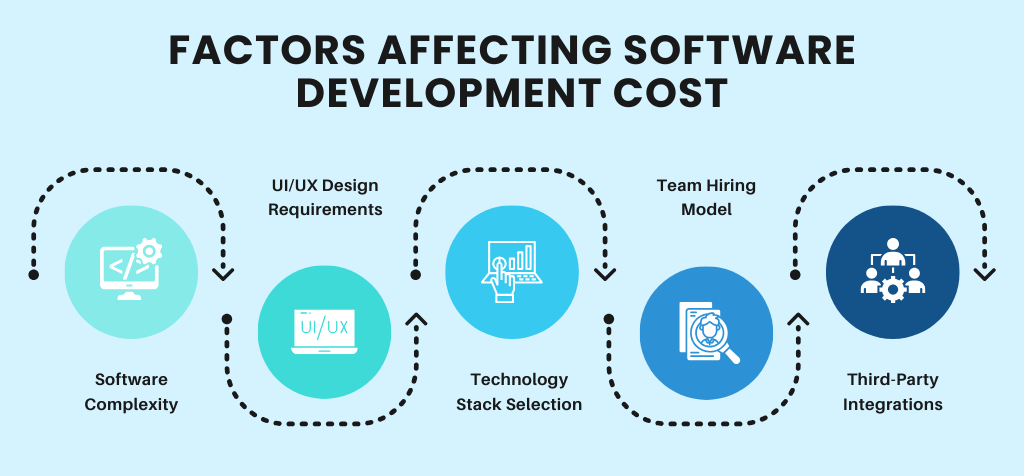
Before conducting a thorough cost analysis, it is critical to understand the key variables that influence this type of budget. The factors that influence the average cost of custom software development affect not only the initial investment but also long-term scalability and overall ROI.
Software Complexity
Development effort rises with the complexity of the software logic, workflows, and functionality. Advanced features like multi-user architectures, AI-driven modules, or real-time processing greatly raise testing needs, planning, and development time.
UI/UX Design Requirements
Beyond aesthetics, user-centered design is unparalleled. Simple user experiences, access standards, and multi-device responsiveness all add value but come at a cost. Excellent UI/UX design has a direct impact on user adoption and long-term success.
Technology Stack Selection
Estimates of cost depend mostly on the selection of frameworks, databases, and programming languages. Though they need a larger preliminary investment, scalable stacks cut future maintenance and upgrade costs.
Team Hiring Model
How you build your development team matters. In-house teams, outsourcing, or choosing to hire custom software developers as dedicated resources each come with different cost structures. The right model balances expertise, flexibility, and budget efficiency.
Third-Party Integrations
Combining payment gateways, external APIs, or corporate systems increases complexity. Especially for B2B software, the overall development cost typically covers licensing fees and continuous dependence management to guarantee smooth operations over corporate systems.
Read More: How Much Does It Cost to Develop an iOS App
Affordable Custom Software Project Cost Breakdown
Before diving into the numbers, it’s important to understand how custom software development cost is calculated across different project stages. Here’s a typical software project cost breakdown:
Stage | Description | Estimated Cost Range |
| Discovery & Planning | Requirements gathering, feasibility analysis, project roadmap | 5–10% of total budget |
| Design & Prototyping | UX/UI design, wireframes, interactive prototypes | 10–15% of total budget |
| Development | Frontend & backend coding, API integrations, database setup | 40–50% of total budget |
| Testing & QA | Functional, performance, security testing, bug fixing | 10–15% of total budget |
| Deployment | App release, server setup, production environment launch | 5–10% of total budget |
| Maintenance & Upgrades | Post-launch support, feature updates, performance optimization | 10–15% of total budget |
Hidden Costs to Consider in Software Development Projects
Hidden expenses are frequently disregarded but can have a major effect on custom software development cost, and long-term ROI must be taken into account before finishing your software development budget.
- Third-Party APIs & Licenses: Including outside services such as payment gateways, analytical tools, or mapping APIs increases license fees and use expenses, therefore affecting the general custom software price.
- Cloud Hosting & Infrastructure: Reliable hosting, servers, and cloud infrastructure can significantly impact your software development budget, particularly for scalable enterprise solutions, by enhancing performance and uptime.
- Post-Launch Maintenance: Maintaining a program that is working and safe depends on regular bug fixes, updates, and performance monitoring—which affects cost and lifespan.
- Security & Compliance Updates: Regular inspections and changes are needed to guarantee data security, GDPR, HIPAA, or industry-specific compliance, hence increasing the price of enterprise software.
- Scalability & Performance Optimization: As software development for logistics and other high-demand sectors sees user bases expand, scaling servers, refining databases, and boosting performance become required.
Custom Software Cost by Type of Service
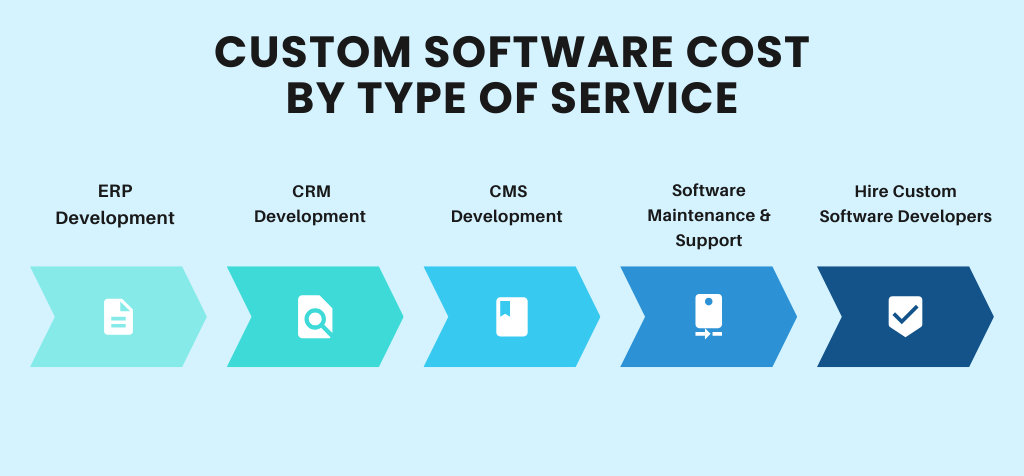
Considering features, integrations, and user interface, every program has its own complexity level. The cost is mostly determined by the overall scope of the project. Popular software categories you could use to calculate the cost of your software development project:
ERP Development
Enterprise Resource Planning (ERP) software combines vital business operations like human resources, finance, and inventory management. Pricing is directly affected by modules and workflow complexity.
The number of incorporated modules, automation needs, and reporting capabilities determines the price of ERP development. Highly customized ERP systems featuring multi-location assistance or strong analytics can greatly raise the cost of ERP software development in 2026.
Small installations usually cost from $50,000 to $500,000+ for enterprise-grade solutions with sophisticated features, connections, and scalability considerations.
CRM Development
The pricing of CRM software development in 2026 relies on feature complexity, cross-compatibility with other business systems, and personalized dashboards. Basic CRM solutions are less expensive in comparison to advanced CRMs customized for sales automation, analysis, and reporting, which increase the capital needed.
Depending on features, integrations, and degree of customization to meet particular corporate demands, prices for CRM development might range from $20,000 to $200,000.
CMS Development
Companies can efficiently control their web material using Content Management Systems (CMS). For more adaptable, API-driven designs, costs differ between traditional CMS and headless CMS.
Design needs, content migration, workflow automation, and SEO features all influence the CMS software development cost for a small business. Flexible and multi-platform distribution requirements can cause headless CMS systems to cost more.
CMS development typically costs $15,000–$40,000 for basic platforms, with custom features or complex integrations increasing the final price.
Software Maintenance & Support
Investing in software maintenance and support reduces long-term costs by preventing downtime, optimizing performance, and ensuring compliance with evolving standards.
While annual contracts may offer more complete services with consistent pricing advantages for maintained activities, monthly plans can start between $500 and $1,500.
Hire Custom Software Developers
The expenses of hiring custom software developers in the USA depend on factors like expertise, geographical location, project length, and engagement model. Dedicated teams bring total accountability from start to finish, whereas freelancers might cut down costs but will need closer monitoring.
For large companies looking for scalable solutions, employing dedicated developers guarantees consistency throughout the project, quality control, and long-term maintainability, which usually makes the cost justifiable compared to using temporary or scattered teams.
Read More: How to Choose the Right ERP for the Food and Beverage Industry
Ways to Reduce Your Custom Software Development Cost
Custom software development costs can be reduced without sacrificing quality; instead, careful planning and wise decisions can help you manage your budget more effectively.
- Prioritize MVP Features: Concentrate on basic functions first to give a quicker launch, reduce the major investment at the beginning, and check the ideas before spreading.
- Use Modular Architecture: Develop the application in separate, reusable sections to make the updating process easier, lower the future development cost, and increase the maintainability of the project.
- Offshore vs Local Talent: Make use of the offshore programmers for the cost advantage while ensuring that the quality and communication are good with the local groups for the important jobs.
- Reuse vs Rebuild Components: Use the existing libraries, frameworks, or code wherever possible to reduce the time taken, the errors made, and the overall cost of the development.
Why Choose Software Development from Diginautical
When selecting a partner for custom software development, it’s important to choose a team that blends technical expertise with strategic business insight. Diginautical offers the following advantages:
Industry Expertise
Knowing the particular demands of industries like finance, ecommerce, logistics, and agriculture, our developers guarantee customized solutions that genuinely meet sector needs.
Affordable Pricing
Simple pricing of custom software helps companies to create budgets accurately, thus avoiding secret expenses and allowing better investment choices.
Scalable Solutions
Growing with your company, our future-ready software systems adapt to more users, functionality, and connections without difficulty.
Dedicated Teams
Customers can deal directly with our specialists or recruit committed development teams, therefore guaranteeing targeted execution, responsibility, and flexibility throughout the course.
Ongoing Support
Post-launch monitoring, optimization, and maintenance help your program to be safe, current, and consistent with changing corporate goals.
Read More: Why Diginautical Is the Perfect Partner for Enterprise Software Development
Final Thoughts
Estimating custom software development cost is about more than just numbers; it’s about appreciating the worth your program provides to your company. Although project complexity, technology, and features affect costs, giving quality and scalability top priority guarantees long-run advantages and sustained expansion. Diginautical combines transparent custom software pricing with expert guidance to help you make informed decisions.
Frequently Asked Questions
Project complexity, technology stack, integrations, and team structure all directly impact overall costs.
Yes, scalable solutions and MVP-focused development make tailored software accessible for businesses of all sizes.
Adding APIs, payment gateways, or enterprise tools increases development effort, licensing, and maintenance requirements.
Offshore talent can reduce costs, but quality, communication, and time zones must be carefully managed.
Plan for updates, security, scalability, and support; factoring these into your budget avoids surprises post-launch.