

As the year 2026 draws near, individuals must acknowledge that the digital realm has conquered the entire business landscape. Wherever you see startups testing their first ideas, you’ll find mobile apps right next to large enterprises engaging customers and serving as the focal point of the digital strategy.
In the digital climate, where launching a new app is almost done every minute, the burning question, “What will be the cost of my app’s development?” is one keeping business owners and product teams awake all night long. It does not matter if you are a startup setting sights on growth or an enterprise willing to refresh your digital presence; looking for affordable mobile app development services that maintain quality is of paramount importance in today’s world.
According to recent industry data, the cost of developing a mobile app in 2026 is wide-ranging; for example, one guide estimates that building a “basic” app today can cost anywhere from US $40,000 to $100,000, while more complex or enterprise-grade solutions can cost over $400,000.
“We help businesses invest wisely, because every smart app begins with a smart budget.” – Mubashir Faiz, CEO at Diginautical
No matter if you are preparing the budget for a simple MVP or an entire enterprise solution planning, this article will assist you in making the right decision in terms of building, spending, and planning.
What Factors Influence the Mobile App Development Cost
The cost of creating a mobile app in 2026 depends on multiple variables, from the app’s design and platform to its technical complexity and team structure. It is not an easy task to find the exact price for an application development; rather, you have to go through the process of estimating it.
The case is similar with the enterprise mobile app development possibilities or the custom mobile app for starters; still, there are a few factors that can cut the final cost.
Among the factors that have a huge influence on your mobile app development cost, four of them are most important:
1. Platform Choice (Android, iOS, or Cross-Platform)
Cross-platform advantages such as Flutter or React Native may deliver cost savings through code sharing; however, there might be slight performance trade-offs involved.
- How to save: Select a single platform for your MVP and then expand based on user feedback.
- Consequences of saving: Attracting the audience early on can be difficult, as only one platform will be offered in the beginning.
2. App Complexity and Features
A basic app might be within financial reach, but the costs of an enterprise-grade solution can get multiplied by advanced integrations and performance optimization.
- How to save: Start with core functionalities only and improve through updates or feedback from users.
- Consequences of saving: The app may not attract much initial interest, or it may not be able to gain traction in the market if it is too simple.
3. Design and User Experience (UI/UX)
The decision to go for professional mobile app development services that are custom-made to your needs will not only make your app look good but also facilitate its flawless function across the various devices.
- How to save: For the initial versions, put existing design systems or templates to use.
- Consequences of saving: substandard design might result in the app being rejected and reviews being negative.
4. Development Team and Location
The cost can be very different according to the decision you make, that is, whether you are going to hire a local agency, offshore developers, or an in-house team. Companies that provide mobile app development solutions to enterprises typically charge higher fees; however, they provide full-cycle services, including design, deployment, and post-launch support.
- How to save: Appointing a shrewd development partner in a low-cost region can be an effective strategy for the cutting of costs.
- Consequences of saving: Opting for less expensive teams that lack technical know-how might result in substandard code and thus more maintenance costs in the future.
Cost Breakdown by App Type
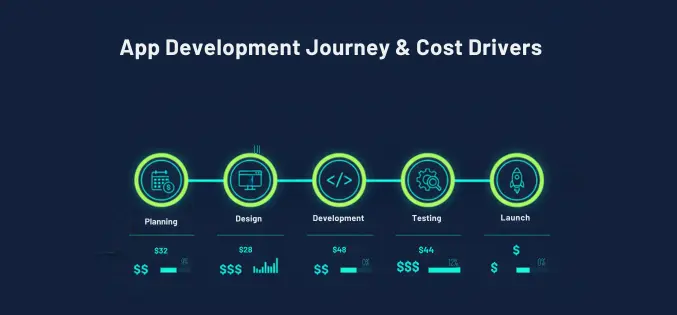
Let’s understand how app complexity impacts cost; it is essential before you initiate your project. If you are funding a startup via mobile app development services or if you are looking at mobile app development solutions for corporates, the intricacy of your application will specify the total time, necessary resources, and cost.
1. Simple Apps
These apps have limited functionality and a straightforward user interface. They include essential features such as login, user profile, notifications, and basic content display.
Estimated Cost (2026): $30,000 to $60,000
Examples:
- Basic utility apps (calculators, reminders, note-taking)
- Informational business apps
- Entry-level MVPs for startups
2. Medium-Complexity Apps
Medium-level apps feature more screens, integrations, and real-time interactions. They often require backend development, APIs, and custom UI/UX.
Estimated Cost (2026): $60,000 to $150,000
Examples:
- eCommerce apps with payment systems and product catalogs
- On-demand delivery apps with order tracking
- Social media apps with chat or media-sharing features
3. High-Complexity Apps
Enterprise-grade applications demand advanced architecture, integrations, security layers, and multi-role functionalities. These apps often support thousands of users simultaneously and integrate with CRMs, ERPs, or custom APIs.
Estimated Cost (2026): $150,000 to $400,000+
Examples:
- Enterprise internal apps for operations, HR, or analytics
- Gaming apps with 3D environments or multiplayer modes
- AI-driven platforms and large-scale financial or logistics solutions
How to Choose Diginautical as Your App Development Partner
Choosing a suitable development partner is among the most important choices during your app’s lifecycle. It does not matter if you are a startup or a big company; your aim should be to discover a collaborator who is not only a fast coder but also comprehends your business vision.
1. What to Look for in a Development Partner
Prior to contract signing, consider the factors of the agency’s experience, portfolio, communication, and post-launch support. An entity that provides total mobile app development services must be open about its method, technology stack, and cost. Assess their former works to gain insight into their proficiency in various sectors and technologies. A reliable partner is always having consistent communication and even collaboration through agility.
2. In-House vs. Agency vs. Hybrid Teams
Each model has its own strengths.
- In-house teams provide complete control but come with higher overhead costs and limited scalability.
- Agencies offer specialized skills, structured workflows, and rapid scalability at a predictable cost.
- Hybrid teams are the best of both worlds, combining internal strategy with external technical expertise.
Partnering with a proficient agency that provides end-to-end mobile app solutions often guarantees quicker delivery, professional advice, and availability of specialized manpower in both Android app and iOS projects.
3. Ask the Right Questions Before You Begin
Before you hire mobile app developers or sign an agreement, ask questions that clarify scope and expectations.
- What are the estimated hourly rates or project costs?
- What deliverables and milestones are included in each phase?
- How long will development take, and what’s the communication rhythm?
- What post-launch support or maintenance services are included?
These discussions prevent surprises later and help align goals between you and your development partner.
4. Why Partner with Diginautical?
At Diginautical, we are not merely involved in the creation of applications; rather, we are engaged in the development of digital experiences that result in the growth of the business. The development of mobile apps is carried out by our expert team for both startups and enterprises, and we make sure that every project is of the highest quality in performance and design.
The hiring of mobile app developers from Diginautical means that you will have a team of professionals who are fully committed to working with you in a spirit of trust, flexibility, and long-lasting success.
Wrapping Up
The cost of developing a mobile app continues to rise year after year, but it can fluctuate depending on market conditions, similar to the price of luxury real estate or stocks. If you’re ready to turn your idea into an impactful mobile experience in 2026, connect with Diginautical today to explore affordable mobile app development services that match your vision and budget.