


Rising at a remarkable rate of nearly 22% CAGR, the worldwide artificial intelligence market is booming like never before. Valued at around USD 758 billion in 2025, it’s expected to soar past USD 2 trillion by the early 2030s.
Companies that understand artificial intelligence development in 2026 can change their operations and competitive placement. From financial institutions automating risk analysis to healthcare systems using predictive diagnostics, AI development is more than simply a tool; it is a transforming power of insight and efficiency. Companies that delay the introduction of artificial intelligence risk losing ground to more agile, smarter rivals.
This comprehensive AI development guide covers the entire process of building AI systems, including planning, data strategy, model selection, development, and deployment. Using the mentioned principles, it is possible to design scalable and business-focused AI.
Understanding Artificial Intelligence in 2026
The concept of AI development in 2026 extends far beyond simple predictive analytics. Modern AI includes several specialized types, each of which powers different real-world applications.
- Generative AI: Creates text, images, audio, and video from data inputs.
- Chatbots and Voice Assistants: Highly developed interactive AI that comprehends and replies to human language.
- Vision AI: Advanced systems for detecting objects and recognizing images.
- Autonomous AI Agents: Machines capable of making fully independent decisions.
- Edge AI: AI systems that operate locally on devices, ensuring speed, efficiency, and data privacy.
Organizations that invest early in structured AI development processes gain more than automation; they achieve greater insight and the capability to grow innovation responsibly. — Syed Irtiza Ali, Brand Manager at Diginautical
What AI Development Approaches to Use in 2026?
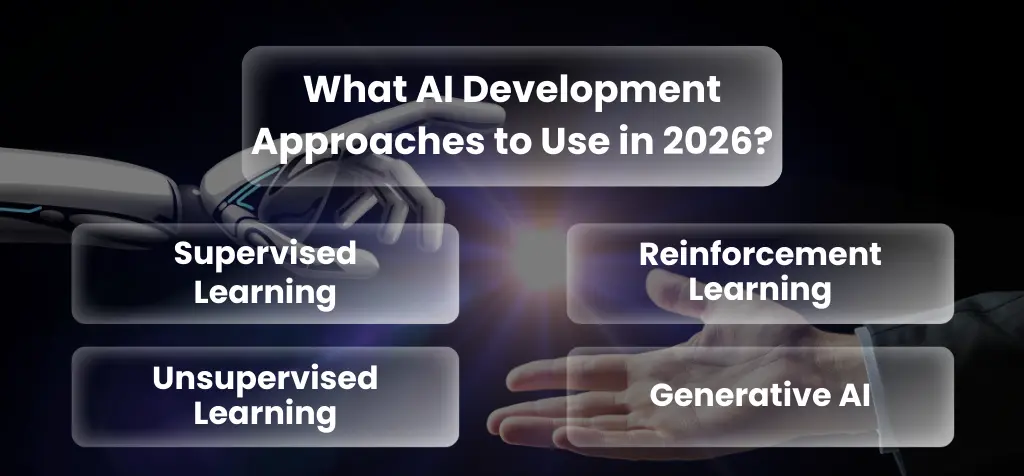
Choosing the right method is crucial for an effective AI development process. Here are the most popular of them:
1. Supervised Learning
Supervised learning uses labeled datasets to train artificial intelligence algorithms capable of precisely predicting results. Using neural networks and deep learning models, supervised learning produces trustworthy, understandable results that make it the preferred technique for enterprise artificial intelligence applications.
2. Unsupervised Learning
Unsupervised learning looks for underlying patterns and structures by means of unlabeled data analysis. It is perfect for customer segmentation, outlier identification, and suggested systems. This method helps businesses support cost-effective and exploratory artificial intelligence projects by letting them gain insights without making a lot of investment in data labeling.
3. Reinforcement Learning
By rewarding desired behaviors, reinforcement learning instructs AI agents to make sequences of choices. Dynamic logistical optimization, robotics, and autonomous vehicles often make use of it. Although expensive in resources, it is great in situations needing ongoing learning and adaptation.
4. Generative AI
Generative AI generates fresh material, including text, pictures, music, and video, using deep learning algorithms and neural networks. It drives creative design tools, content creation, and applications, including sophisticated AI chatbots. Companies can fine-tune generative models to achieve domain-specific accuracy while reducing development time.
Choosing the right path is a huge factor for the success of machine learning and AI development; it gives the guarantee that AI solutions will be efficient and in tune with the company’s strategy.
How to Make Artificial Intelligence App: Step-by-Step Guide
Here is the step-by-step guide for the effective building of AI systems:
Step 1: Define Business Problem and Scope
Begin by determining which particular issue your artificial intelligence will fix. Clearly spell out the aims, KPIs, and scope of execution for your AI app development initiative. This helps to make sure that the next stages in AI programming are results-oriented and targeted.
Step 2: Data Collection and Preprocessing
Gather appropriate datasets, then eliminate discrepancies by cleaning, normalizing, and preprocessing them. Good data training for artificial intelligence models guarantees correct forecasts and lowers bias in outcomes.
Step 3: Choose AI Models and Algorithms
Based on the kind of issue, choose suitable artificial intelligence algorithms, neural networks, or deep learning techniques. Supervised learning models fit predictive jobs; for example, generative AI may manage content creation or sophisticated chatbots.
Step 4: Train, Validate, and Test Models
Feed your preprocessed data into the chosen models, iteratively adjusting parameters to improve performance. Check the models often to guarantee dependability in actual conditions. For ongoing improvement, this cyclical process is essential.
Step 5: Deploy and Monitor
Deploy the AI system in a production environment and monitor its performance. Gather user comments, monitor KPIs, and retrain models as necessary. Effective artificial intelligence implementation in 2026 stresses constant iteration and refinement to fit changing corporate demands.
Read More: How AI is Revolutionizing Mobile App Development
How Much Will Artificial Intelligence Cost in 2026
The cost of AI web development in 2026 varies greatly depending on project complexity, the type of AI solution, and the resources required.
| AI Development Approach | Estimated Cost Range | Notes |
| Supervised & Unsupervised Learning | $5,000 – $50,000 | Suitable for predictive analytics, classification, and clustering tasks with moderate data requirements. |
| Reinforcement Learning | $50,000 – $500,000 | Resource-intensive; ideal for robotics, autonomous systems, and dynamic decision-making applications. |
| Generative AI | $20,000–$400,000 | Costs depend on model complexity and content output (text, image, audio, or video). |
| Custom AI from Scratch | $500,000 – $10,000,000+ | Complete proprietary systems needing large datasets, high-performance hardware, and a dedicated research team. |
Technical Stack for AI Development
Choosing the right tools is an important step in developing artificial intelligence that is efficient and consistent across industries such as manufacturing, finance, and automotive.
- Frameworks: TensorFlow and PyTorch are still the principal tools for AI model creation. They allow efficient building and experimenting with neural networks and deep learning models over a wide range of applications, such as predictive analytics and computer vision.
- Data Platforms: Data training for AI is significantly aided by cloud-based and on-premise platforms, which provide secure storage, preprocessing capabilities, and large-scale dataset management. Data pipelines that are properly structured are indispensable for obtaining accurate and reliable AI outcomes.
- AutoML and Cloud AI Suites: Google Vertex AI, Microsoft Azure AI, and Amazon SageMaker are examples of platforms that facilitate the process of model creation, hyperparameter tuning, and deployment. They reduce the technical barrier for businesses exploring AI development in 2026.
- Generative AI Solutions: The availability of specialized tools for text, vision, and multimodal AI allows the companies to establish their own advanced applications in content generation, virtual assistance, and designing tools; hence, custom AI development with reduced resource use.
- Enterprise AI Development Services: For companies without in-house AI expertise, outsourcing to enterprise service providers ensures compliance, efficiency, and faster implementation.
Overcoming Challenges in AI Development
Companies exploring how to make artificial intelligence must address these obstacles carefully to ensure success.
| Challenge | Description | Solution |
| Data Quality Issues | Model performance can suffer in the case of datasets that are incomplete, inconsistent, or biased. | Data training for AI should be augmented using data augmentation, synthetic datasets, and strong preprocessing pipelines. |
| Bias and Fairness | AI models may reflect biases present in historical data. | Regularly monitor datasets for fairness, deploy fairness-aware algorithms, and check outcomes from several case studies. |
| Scalability Challenges | Large AI models can strain infrastructure and slow inference. | Retain performance at large through model optimization strategies such as pruning, quantization, or cloud-based distributed computing. |
| Ethical and Regulatory Concerns | The actions of AI systems can have a major effect on their human counterparts, and thus, the need for transparency arises. | Maintain ongoing monitoring of AI behavior in production, guarantee regulatory compliance, and apply explainable AI systems. |
Future AI Trends that Will Reshape the World
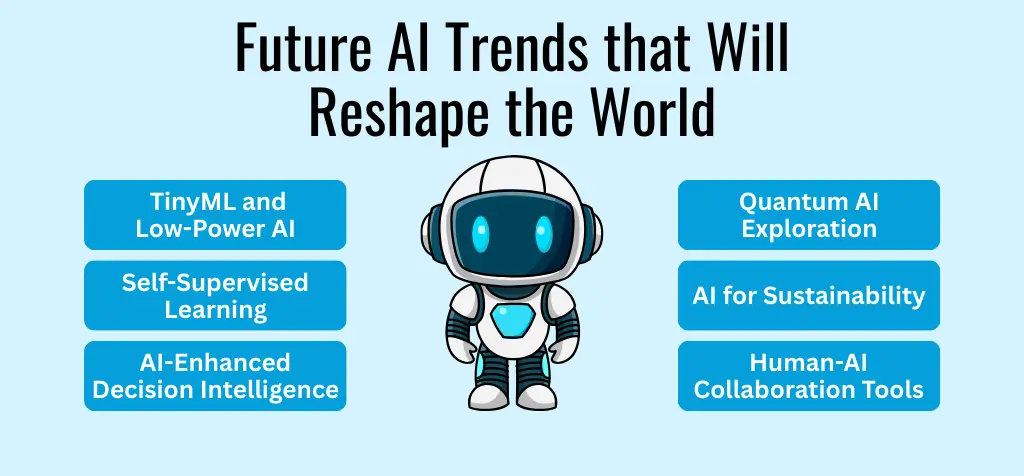
These trends highlight AI use cases in 2026 that go beyond conventional applications:
1. TinyML and Low-Power AI:
It enables predictive maintenance, environmental monitoring, and wearable applications without depending on cloud infrastructure by optimizing AI models for very low-power gadgets.
2. Self-Supervised Learning:
This tendency lowers the expense and labor of data training for artificial intelligence and enables organizations that hire AI app developers to build intelligent solutions even in sectors where labeled data is limited.
3. AI-Enhanced Decision Intelligence:
AI is shifting from forecast to prescriptive action by offering real-time recommendations, risk ratings, and decision pathways. Businesses may now directly incorporate artificial intelligence insights into strategic planning.
4. Quantum AI Exploration:
Early uptake of quantum computing is expected to speed optimization challenges, sophisticated simulations, and drug development, therefore producing hitherto unknown artificial intelligence growth opportunities in 2026.
5. AI for Sustainability:
Standard AI applications are developing along with AI-driven energy optimization, supply chain emissions monitoring, and resource-efficient manufacturing; this matches invention with environmental responsibility.
6. Human-AI Collaboration Tools:
Increasing popularity of tools enabling humans and artificial intelligence to co-create material, evaluate data together, or co-plan strategies transforms AI from just a tool into a genuine partner.
Conclusion: Your Next Step into the AI World
In 2026, developing artificial intelligence will require more than just technology; it will also necessitate the development of an appropriate strategy, knowledge, and execution partner. Good artificial intelligence projects, as this development manual has demonstrated, rely on precise business goals, high-quality data, thoroughly chosen models, and ethical deployment strategies.
Diginautical offers whole solutions customized to corporate requirements, ranging from AI strategy and bespoke development to implementation, scaling, and governance. Working with our brand guarantees a methodical approach to artificial intelligence that powers efficiency, expansion, and long-term value for businesses willing to invent and remain competitive.
Frequently Asked Questions
By starting with clearly defined business KPIs and choosing the simplest AI model that delivers measurable value before scaling complexity.
Custom AI is ideal when proprietary data, strict compliance requirements, or competitive differentiation are critical to the business.
Most well-scoped AI initiatives begin delivering value within 3–6 months when aligned with operational workflows.
Yes, with continuous monitoring, retraining, and MLOps practices to prevent model drift and performance decline.
Strong governance ensures transparency, regulatory compliance, and trust, reducing risk while enabling sustainable AI adoption.