


With mobile apps powering everything from banking to healthcare, businesses are under more and more pressure to follow best practices for mobile app security that keep users’ private information safe. According to insights shared by IBM, the average cost of a data breach reached $4.45 million globally, highlighting the financial impact of weak security measures.
Implementing secure mobile app development practices is essential for building secure fintech mobile applications and ensuring compliance in mobile app security for healthcare apps, where regulatory standards are strict and unforgiving. To address these challenges, businesses are increasingly relying on custom mobile app development services that integrate security at every stage of the development lifecycle.
Implementing the right mobile app security practices is the foundation of building applications that users can truly trust. – Syed Irtiza Ali, Brand Manager at Diginautical
When making apps for iPhones or Androids, they must be built from the ground up with encryption, secure authentication, and strong backend protection. Organizations can lower risks, keep user data safe, and make apps that users trust by putting security first from the start.
Read More: Step-by-Step Guide – Mobile App Development Process for Businesses
Why Mobile App Security Matters in 2026
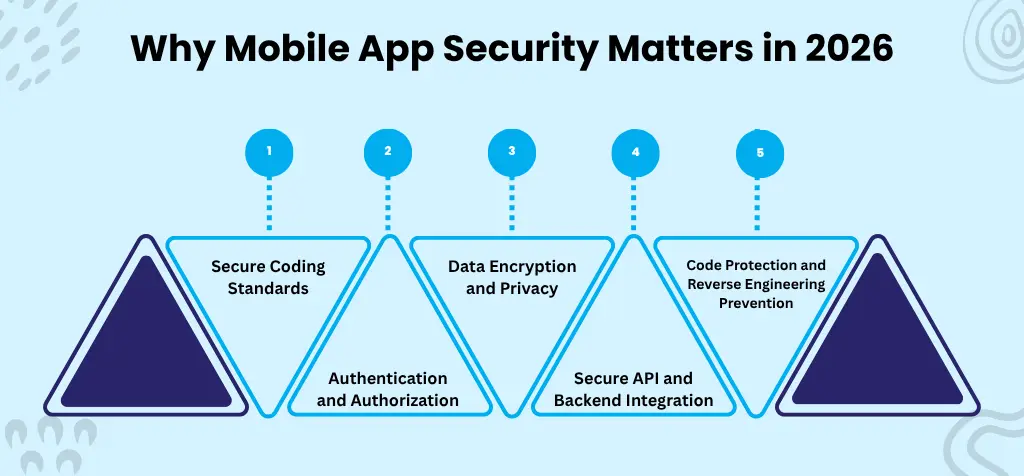
Mobile applications have become critical business assets, making mobile app security best practices and advanced mobile app cybersecurity strategies essential. Companies investing in custom mobile app development services and custom software development services must prioritize security to protect data, maintain trust, and ensure long-term operational stability.
Rising Mobile Threats and Vulnerabilities
Cyber threats are evolving rapidly, with attackers exploiting common mobile app vulnerabilities such as insecure APIs and weak authentication. According to emerging mobile app security trends 2026, even hybrid mobile app development services face increasing risks, shaping the future of mobile cybersecurity.
Business Risks of Insecure Apps
Failing to meet mobile app security regulation compliance can result in severe financial penalties and legal consequences. Insecure apps, including poorly built solutions within iOS app development services, expose businesses to mobile app supply chain security risks, reputational damage, and significant revenue loss.
Read More: 15 Useful Tips for a Successful Mobile Application
Core Mobile App Security Best Practices
To make a safe app, you need to take a structured approach and make sure that every layer of development follows best practices for mobile app security. Businesses can improve the security of their mobile apps and lower the number of vulnerabilities throughout the app lifecycle by following mobile application security guidelines and a full mobile app security checklist.
Secure Coding Standards
Implementing secure coding standards for mobile apps is the foundation of secure mobile app development, especially in complex environments like hybrid mobile app development services. Developers must focus on clean, secure code to minimize vulnerabilities and ensure long-term application stability.
- Over 60% of mobile vulnerabilities originate from insecure coding practices
- Regular code reviews can reduce security flaws by up to 40%
Authentication and Authorization
Strong, secure authentication methods, such as multi-factor authentication in mobile apps, are important parts of the best practices for mobile app security. Adding secure access controls to systems like ERP development services makes sure that only people who are allowed to see sensitive data can do so.
- Multi-factor authentication can block over 99% of automated cyberattacks
- Weak passwords remain one of the top causes of security breaches
Data Encryption and Privacy
Applying encryption for mobile applications is critical for ensuring mobile app privacy protection and meeting mobile data encryption best practices, especially in apps built with cross-platform development services. Encryption safeguards sensitive data both in transit and at rest.
- Encrypted apps reduce data breach risks significantly
- Over 70% of users prefer apps with strong data privacy protections
Secure API and Backend Integration
Robust API security for mobile apps and effective mobile API threat mitigation are vital for secure backend integration for mobile apps, particularly in platforms powered by CMS development services and custom mobile apps. Securing backend communication prevents unauthorized data access.
- APIs account for nearly 90% of web-enabled application vulnerabilities
- Proper rate limiting can prevent large-scale automated attacks
Code Protection and Reverse Engineering Prevention
Code obfuscation, anti-tampering, and reverse engineering prevention are all advanced techniques that improve mobile app security best practices. Using runtime application self-protection (RASP) keeps apps safe even when they are running in places that aren’t trusted.
- Deception can make reverse engineering up to 80% more difficult
- Runtime protection helps detect threats in real time before damage occurs
Read More: How to Build Mobile Apps with Flutter
Mobile App Security Testing Strategies
Ensuring application security requires a structured approach that combines proactive testing with continuous monitoring. Implementing effective mobile app security testing strategies helps businesses identify vulnerabilities early, strengthen defenses, and align with industry-recognized mobile app security best practices.
Automated and Manual Testing Approaches
A balanced mix of automated and manual testing is essential for identifying security gaps. Techniques such as static and dynamic analysis, threat modeling, and frameworks like OWASP MASVS and MSTG enhance mobile app penetration testing and support advanced mobile app threat analysis services.
Continuous Monitoring and Threat Detection
Ongoing security is critical for modern applications, especially in sectors like ecommerce web development. Implementing mobile threat detection and monitoring with real-time alerts, logging, and auditing enables businesses, including any ecommerce software development company, to quickly detect and respond to potential threats.
Read More: Top Android App Development Trends to Watch
Secure App Development Across Platforms
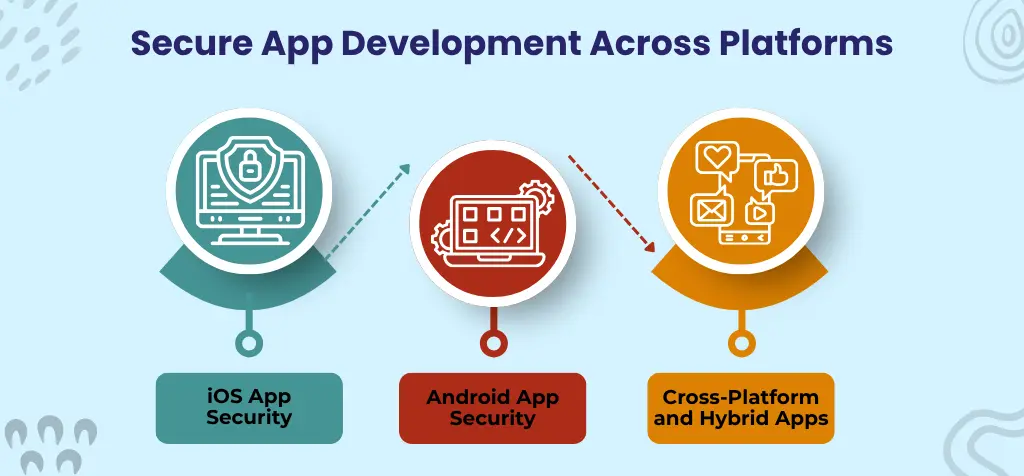
Secure application development for various platforms requires businesses to implement development methods that build applications and utilize security practices from each specific platform.
Businesses that provide secure mobile application development services work with experts to protect their systems by hiring custom software developers throughout all operational environments, from mobile app development in Florida to their custom mobile app development services in the USA.
iOS App Security
In iPhone app development, ensuring secure mobile app development involves using Apple’s built-in security architecture. Developers implement Keychain storage for sensitive data, enforce App Transport Security (ATS) for encrypted communication, and use code signing to maintain application integrity and authenticity.
- iOS apps with ATS enabled can reduce data interception risks by over 60%
- Apple’s ecosystem provides strict app review processes for added security
Android App Security
For Android app development, following mobile app security best practices is essential due to the platform’s open nature. Secure implementations include encrypted shared preferences, code obfuscation using ProGuard and R8, and compliance with Play Store security checks to minimize vulnerabilities.
- Over 70% of mobile malware targets Android devices due to open-source flexibility
- Regular updates and patches significantly reduce exploitation risks
Cross-Platform and Hybrid Apps
Modern applications built through cross-platform app development and hybrid mobile app development require additional security layers. Using frameworks like Flutter, React Native, and Xamarin, developers ensure consistency while applying secure mobile application development services such as rigorous plugin validation and dependency audits.
- Cross-platform apps can reduce development costs by up to 30%
- Security audits of third-party libraries help prevent hidden vulnerabilities
Read More: iOS vs Android App Development: Which Platform Should Your Business Choose
Mobile App Security vs Web App Security
For organizations working with a logistics software development company or investing in web development services and custom mobile app development services, it is important to align security strategies with the platform being used. One critical aspect is understanding that APIs act as the bridge between mobile apps and backend systems, making best practices mobile app vs API security a key focus area in modern development.
| Security Aspect | Mobile App Security | Web App Security |
|---|---|---|
| Environment | Runs on user devices with OS-level dependencies (iOS, Android) | Runs in browsers with server-side execution |
| Data Storage | Stores data locally (device storage, cache, Keychain) | Minimal local storage, mostly server-based |
| Threat Surface | Device theft, malware, reverse engineering, insecure storage | XSS, CSRF, SQL injection, session hijacking |
| Authentication | Supports biometrics, multi-factor authentication, device binding | Username/password, MFA via browser sessions |
| API Security | Heavy reliance on APIs for data exchange; requires strong encryption and token security | APIs also used but often protected via server-side validation |
| Offline Access | Can function offline, increasing risk of local data exposure | Requires internet connection, lower offline risk |
| Update Mechanism | Requires app updates via app stores | Updates deployed instantly on server |
| Encryption | Device-level encryption + secure communication (TLS) | Primarily relies on HTTPS and server-side encryption |
| Testing Complexity | Requires device, OS, and environment-specific testing | Browser and server-based testing environments |
| Security Maintenance | Depends on user updates and app version control | Centralized control with immediate patching |
Why Choose Diginautical for Secure Mobile App Development
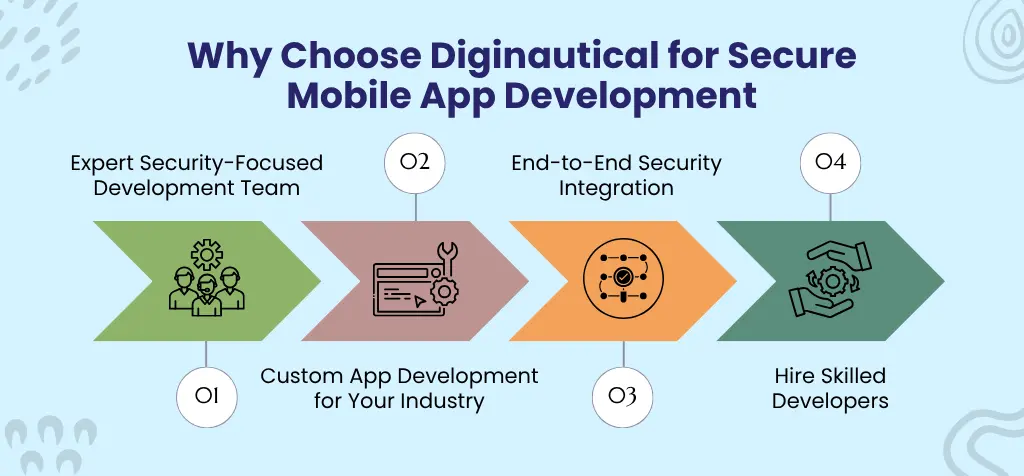
To make applications that are safe, scalable, and fast, you need more than just development. You need a strategic approach based on security, innovation, and industry knowledge. Diginautical offers custom mobile app development services that are meant to keep data safe and help businesses grow.
Expert Security-Focused Development Team
Our team follows proven mobile app security best practices to build robust applications across iPhone, Android, and cross-platform environments. With a strong focus on security-first architecture, we ensure every app is resilient against evolving cyber threats.
Custom App Development for Your Industry
We provide secure mobile application development services tailored to industries like healthcare and ecommerce, ensuring compliance and data protection. As a trusted partner, we design applications that align with industry standards while safeguarding sensitive business and user information.
End-to-End Security Integration
From planning to deployment, we integrate advanced technologies like AI app development services, secure backend systems, and compliance frameworks. Our approach ensures every layer of your application is protected within a structured and secure development lifecycle.
Hire Skilled Developers
Businesses can hire mobile app developers from Diginautical with expertise in enterprise-grade solutions and secure architecture. Our developers deliver scalable, high-performance applications that combine functionality with strong security measures for long-term reliability.
Read More: How to Choose the Best Tech Stack for Mobile App Development
Final Thoughts
Trust is the foundation of strong applications, and it starts with following best practices for mobile app security. Companies that prioritize secure mobile app development are better able to stop breaches, stay compliant, and improve their brand reputation in competitive markets. This is because they protect sensitive user data and make sure that apps work smoothly.
Companies can make apps that are strong enough to protect users and build long-term customer trust by using proven mobile app security methods. When businesses work with experts like Diginautical, they can get custom mobile app development services that include security at every step, from planning and development to deployment and ongoing optimization.
Frequently Asked Questions
A strong mobile app security checklist includes secure coding, data encryption, API protection, and multi-factor authentication. Following these practices ensures secure mobile app development and minimizes risks of data breaches and unauthorized access.
To hire mobile app developers, look for expertise in security-first architecture, compliance standards, and real-world project experience. Choosing professionals offering custom mobile app development services ensures your app is built with security integrated from the start.
Not necessarily. Both hybrid mobile app development and cross-platform app development can be secure if built properly. Using best practices within secure mobile application development services ensures strong protection regardless of the technology stack.
Ensuring mobile app security regulation compliance requires following standards like GDPR or HIPAA, implementing encryption, and managing user data responsibly. Strong mobile data privacy and compliance practices help avoid legal risks and build user trust.