

Heading into 2026, the market of app development continues to grow at a remarkable pace, preparing the stage for major creativity. Businesses have realized that providing a distinct digital experience necessitates more than just a simple app; it necessitates a custom-built solution that aligns with user expectations and long-term goals. According to Forbes, the global mobile app market is still rapidly expanding, making it an ideal environment for businesses willing to innovate.
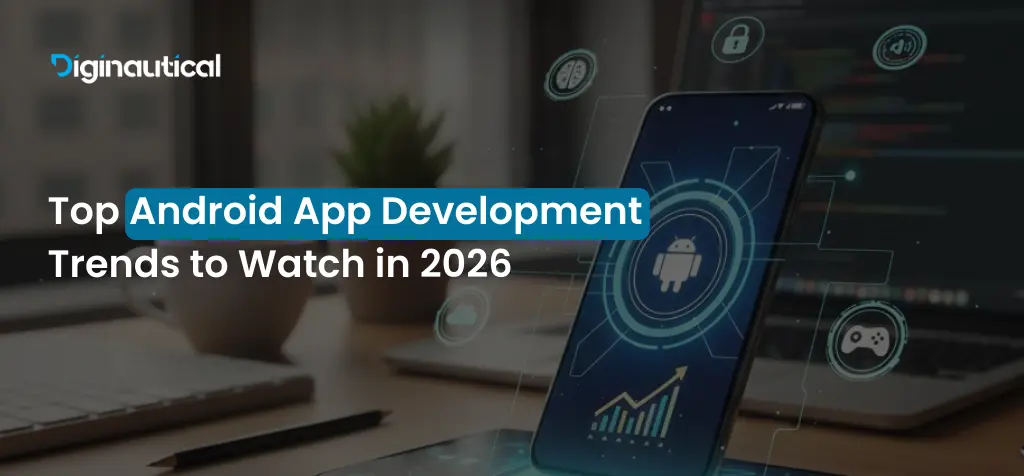
From AI-powered personalization to immersive AR/VR experiences and smarter connectivity via 5G and IoT, the latest Android app development trends in 2026 will transform how apps are built and experienced. By adopting the right approach, applications become more user-friendly, with a deeper understanding of customer behavior and business goals.
The future of mobile app development lies in anticipating trends and creating solutions that genuinely connect with users. – Mubashir Faiz, CEO.
This guide highlights the top Android app development trends to watch in 2026, offering practical insights and real-world examples to help you plan your next app strategically.
Why Will 2026 Redefine Android App Development? Let’s Discover

Every popular Android app by 2026 will not just be a thought but a complete execution of great strategy, advanced technology, and an effective team. Android app development for business is not only a matter of writing code but also of providing creative solutions that attract users, meet their needs, and give measurable benefits. Even the most innovative ideas will not be heard unless they are accompanied by the appropriate strategy.
- Drive business growth and engagement: Apps let you connect directly with your audience, build your brand, and strengthen customer relationships.
- Expand your reach: Mobile apps put products and services into users’ hands anytime, anywhere, increasing visibility and accessibility.
- Boost revenue and conversions: Features like push notifications, personalized offers, and in-app promotions help drive sales.
- Enhance customer loyalty: Intuitive and useful apps encourage repeated interactions and foster long-term relationships.
- Gather actionable insights: Analytics tools embedded in apps provide valuable data on user behavior, preferences, and trends.
- Deliver superior user experiences: Smooth, responsive, and well-designed apps keep users satisfied and reduce churn.
- Ensure security and reliability: Skilled developers prioritize data protection and consistent performance across devices.
- Future-proof your business: Working with the best Android app development company ensures apps are modern and ready to adapt to emerging trends like AI, AR/VR, and 5G.
Generative AI: Content & Features on Autopilot
Generative AI is gradually revolutionizing Android applications by taking over routine tasks like content creation, recommendations, and real-time interactions with the help of artificial intelligence solutions. Besides, the deployment of AI in the apps allows programmers to create smarter and more responsive applications that always reflect user behavior, thus making the apps more immersive and useful.
For the companies that provide Android app development services, these integrations mean that the apps are capable of delivering one-of-a-kind experiences where users interact by playing rather than just being passive consumers.
Why It Matters
Automatically creating hyper-personalized experiences that feel suited to each user, the capacity to produce material and characteristics obviates extra manual effort. For companies, this implies more chances to monetize apps effectively, improved retention, and increased user interaction. By using generative artificial intelligence, companies can develop adaptive, smart apps that keep relevance for consumers in a continuously changing mobile scene and scale very easily.
5G + IoT: Ultra-Fast Apps for Global Connectivity
By facilitating quicker, more dependable connections and almost instantaneous data transfer, 5G network rollout is changing the scope of mobile applications. 5G lets developers create really responsive, networked applications that flawlessly communicate with smart devices, sensors, and systems when coupled with the Internet of Things (IoT). Companies offering Android app development services may use this synergy to meet the latest mobile app trends for Android, developing apps that surpass simple usefulness by providing real-time insights and adaptive capabilities to improve the user experience.
Among examples of this tendency are logistics systems that follow shipments accurately, smart home apps that control thermostats, security cameras, and appliances in real time, and autonomous vehicles that depend on instant data for safe navigation.
Why This Matters:
Low latency ensures faster interactions, enhanced security protects sensitive data, and real-time insights allow for informed decision-making. By embracing these technologies through premium Android app development services, organizations can create future-ready apps that meet changing user expectations.
AR & VR: Say Hello to Your New Virtual Reality
No longer confined to entertainment and gaming, augmented reality (AR) and virtual reality (VR) have found new uses. Android App Development Services allow developers to include augmented reality and virtual try-ons, as well as interactive educational or training modules, into mobile apps for consumers. Real simulations are made possible. This strategy lets companies distinguish themselves by offering visually appealing experiences that are also useful and educational.
Examples include educational programs using VR simulations to teach difficult ideas, healthcare applications giving immersive training for medical experts, and retail apps allowing customers to virtually try on clothing or view furniture in their homes.
Why This Matters:
Immersive AR and VR encounters greatly improve customer interaction, memory, and understanding of goods or services. Expert Android app development services enable applications to be both inventive and scalable by integrating these technologies, allowing businesses to provide unique experiences that meet changing customer expectations and differentiate in a competitive industry.
A Smarter User Journey Built on AI Personalization and Machine Learning
Machine Learning (ML) is empowering Android applications to adapt to consumers in real-time, hence transforming mundane interactions into very individualized experiences. Using Android App Development Services, developers can use ML to analyze behavior patterns, predict demands, and provide tailored material or capabilities for each person. The outcome is an application that resembles more than a personal assistant tool.
Consider fitness applications that modify workout routines depending on progress or news feeds that highlight only what is most important to each reader, as well as e-commerce apps that recommend precisely what a user might want before they even search.
Why This Matters:
For companies putting money on artificial intelligence solutions, this is more than just a passing trend; it is a competitive advantage. Personalized experiences produce devoted customers, closer brand relationships, and trackable expansion in a market where attention is the most priceless commodity.
Choosing the Right Development Approach: Native vs. Hybrid vs. Cross-Platform Services

- Native Development: Built specifically for Android using Java or Kotlin, native apps deliver the best performance, seamless access to device features, and superior user experience. Ideal for complex applications, though development costs and timelines are higher.
- Hybrid Development: Combines web technologies like HTML, CSS, and JavaScript within a native container. Hybrid apps are faster to develop and less expensive, making them appropriate for moderate-complexity projects, but their performance may not be comparable to fully native solutions.
- Cross-Platform Development: Frameworks such as Flutter or React Native allow developers to use a single codebase for both Android and iOS. Cross-platform apps reduce development time and cost while maintaining consistent functionality, though access to advanced device features can sometimes be limited.
- Budget Considerations: Native development is generally the most expensive, while cross-platform solutions are more economical.
- Development Timeline: Hybrid and cross-platform approaches offer faster time-to-market compared to native development.
- Complexity: Apps with advanced features or heavy integration with device hardware may benefit most from a native approach.
- Target Audience: Consider whether you need to reach Android users only or both Android and iOS audiences, which can influence the approach.
- Expert Advice: Align the development choice with your business objectives, app goals, and long-term scalability. Partnering with experienced Android app development services ensures the selected approach maximizes efficiency, performance, and ROI.
Set Up Your Business Goals and Prepare for 2026

Working with professional Android app development services guarantees that your app is designed to properly take advantage of these trends. Whether it be developing a smooth user experience, including the newest technology, or scaling your app for future expansion, we know how to help you realize your idea.
Call Diginautical now to go over your project. Our staff will lead you through the most recent Android app development trends and establish a roadmap for the production of high-performing, future-ready apps that help your company to thrive in 2026 and after.
Frequently Asked Questions
AI integration, 5G optimization, cross-platform frameworks, advanced AR/VR features, and app personalization.
AI will enhance predictive analytics, personalized recommendations, chatbots, and smarter user experiences in Android apps.
Yes, tools like Flutter and Kotlin Multiplatform will remain crucial for faster development and broader device coverage.
Absolutely. As cyber threats increase, Android apps will require stronger encryption, biometric authentication, and secure API integrations.
By adopting AI, AR/VR, and 5G-optimized features, businesses can boost engagement, retention, and revenue in 2026.