

Decisions about automation now influence how effectively modern companies operate, grow, and compete; they are not only technical ones. Selecting the ideal model is now strategic since Gartner forecasts that over 80% of businesses will use AI-powered automation by 2026.
One issue arises constantly in boardrooms and product teams as artificial intelligence grows: AI chatbots vs AI agents what is the actual difference, and which one provides long-term value? Both technologies seem at first glance to offer efficiency and automation. The truth, though, is more complicated. While chatbots focus on conversations, AI agents are designed to act, reason, and operate autonomously across systems.
This guide explains the difference between AI chatbots and AI agents, breaking down each feature in a practical and business-focused way.
What Is an AI Chatbot?
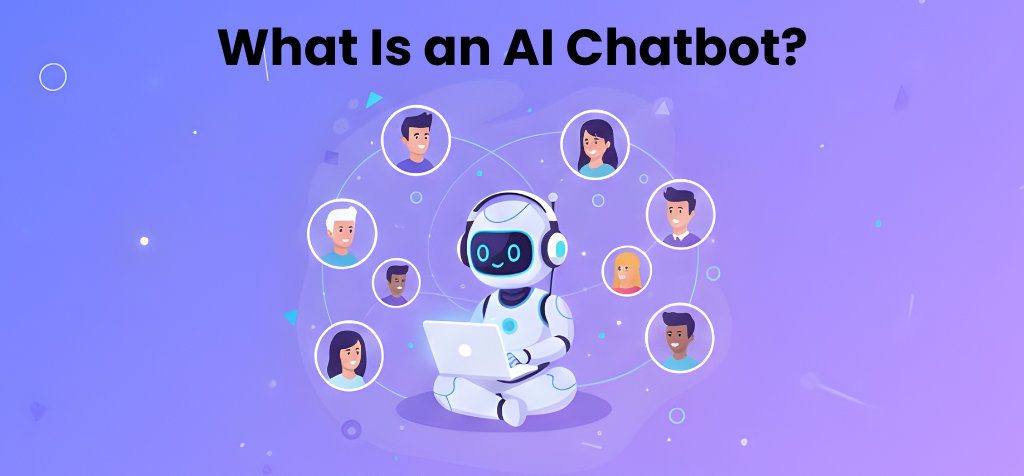
The journey of the AI chatbots from mere scripted responders to versatile artificial supporters has been fantastic. Designed to interact in a human-like manner, they have become the best friends of businesses in providing instant help, supporting, and leading the sales process without having humans intervene all the time.
The main features of the AI chatbot include 24/7 support for customers, answering commonly asked questions, assisting users with their tasks, and gathering data for further communication. These chatbots do not only perform basic processing of user input by keyword matching but rather do so contextually, thus resulting in smoother and more natural interactions. The use of this tool is escalating according to its efficiency for operations, shorter response time, and better customer service.
What Is an AI Agent?
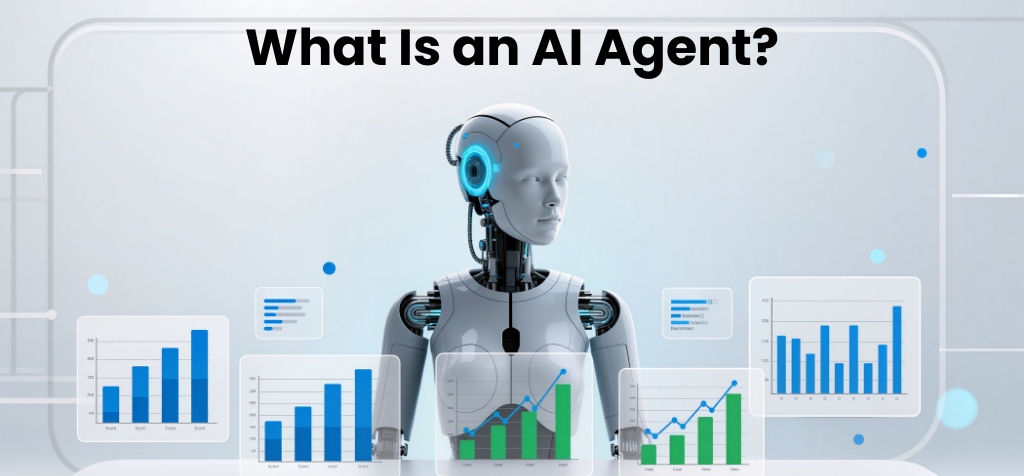
Designed to perform chores proactively, an AI agent is an independent system that makes judgments and takes actions without ongoing human involvement. Unlike chatbots that wait for user instructions, artificial intelligence agents can predict demands, assess context, and run multi-step processes on their own.
AI agent development aims to enable these systems to make educated, independent decisions by combining predictive analytics, reinforcement learning, and sophisticated NLP. Companies looking for proactive, clever automation beyond the reactive scope of conventional chatbots find their independence and adaptability very valuable.
For example, autonomous virtual assistants that schedule meetings, streamline operations, or monitor systems for abnormalities use artificial intelligence agents. Driven by artificial intelligence agents, workflow automation tools can proactively trigger alerts, assign activities, or modify processes devoid of human intervention.
Read More: How to Create Artificial Intelligence
AI Chatbots vs AI Agents: The Real Brain Difference
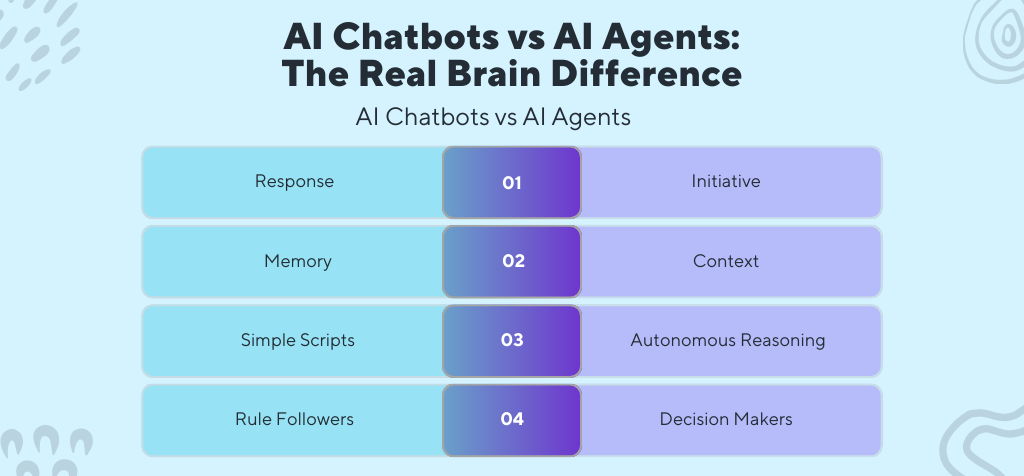
Businesses wanting to successfully incorporate automation need to know the distinction between AI agents and AI chatbots. Although chatbots are great at guided chats, AI agents bring context-aware intelligence, independence, and reasoning to the table.
Their fundamental differences are underlined in the following comparisons:
| Feature | AI Chatbots (Responsive) | AI Agents (Proactive) |
| Response vs Initiative | Waits for user input; reacts to questions or commands. | Takes initiative; anticipates needs and performs actions without being prompted. |
| Memory & Context | Forgets context after each interaction; one-shot responses. | Retains context across steps; handles multi-turn conversations. |
| Reasoning | Follows predefined scripts and patterns; limited adaptability. | Autonomous reasoning; can plan, analyze, and make decisions. |
| Decision-Making | Executes fixed rules; cannot optimize beyond instructions. | Learns and optimizes decisions over time; flexible problem-solving. |
| Scope | Focused on simple tasks like FAQs, basic support, lead capture. | Handles complex workflows, cross-system automation, and dynamic problem-solving. |
| Use Case Impact | Good for reactive customer service and simple engagement. | Best for workflow automation, autonomous assistants, and strategic operations. |
How to Choose Between AI Chatbots and AI Agents

Task Complexity
In the case of simple question-answering, an AI chatbot is enough. In the case of multi-step tasks, decision-making, and adaptive workflows, AI agents are superior. This indicates the practical difference between AI chatbots vs AI agents for businesses.
Level of Autonomy Required
Determine whether you prefer a responsive AI or an autonomous action. In AI web development, chatbots wait for user prompts, whereas AI agents take the initiative by planning steps and completing tasks on their own, emphasizing AI agents’ capabilities over chatbots’ limitations.
Context & Memory Needs
Short, one-time interactions fit AI chatbots. For context retention, user-pattern learning, or multi-turn workflow management, AI agents offer continuity and advanced intelligence, thus clarifying the difference between AI chatbots and AI agents.
Future Growth
Chatbots provide instant deployment for immediate interaction. AI agents are designed for growth alongside changing workflows, gradually taking on more complex operations and automation needs for the future while still being cost-effective and adaptable.
Budget Implementation
AI chatbots need a smaller initial investment and allow for quicker deployment. AI agents have a higher setup cost but provide long-term operational value, advanced functionality, and measurable ROI aligned with automation strategies.
Read More: How AI Is Transforming E-Commerce
Why Choose Diginautical for AI Chatbots & AI Agents Development?
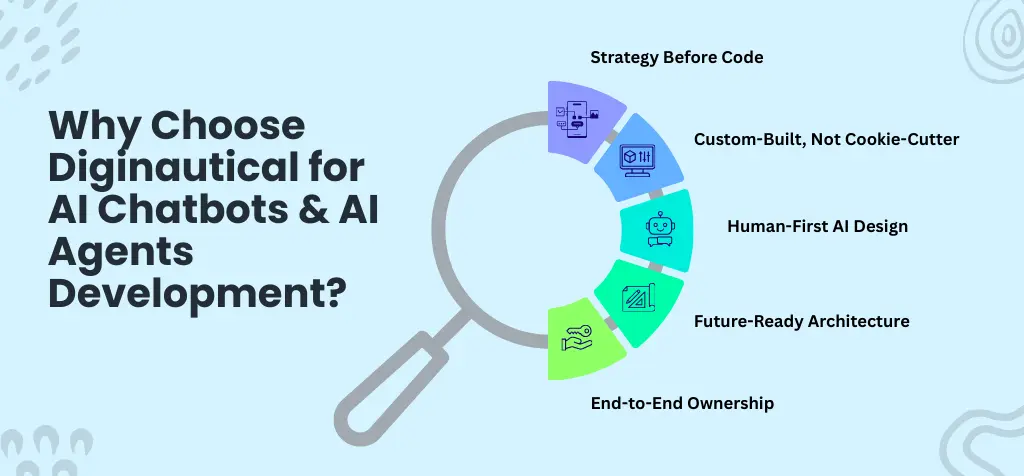
At Diginautical, we view AI chatbots and AI agents as strategic business tools, not buzzwords. Our approach ensures every solution is human-friendly and scalable, delivering measurable results for long-term growth.
Strategy Before Code
In the first place, we examine your business goals and user requirements to find a suitable point where the simplicity of an AI chatbot and the intelligence of an autonomous agent meet
Custom-Built, Not Cookie-Cutter
Each AI solution is built to order, beginning with a proven foundation and evolving through generative AI to match your specific workflows, data structure, and growth objectives whether it’s a conversational chatbot or a fully autonomous AI agent.
Human-First AI Design
Our priorities are clarity, usability, and tone, which make interactions human-like. Users get to see a very useful AI without the confusing part that comes with it, therefore making automation easy and user-friendly.
Scalable & Future-Ready Architecture
Our systems are built with change in mind. A bot today can be transformed into an advanced AI agent tomorrow without losing any of the past work and speeding up the future capabilities.
End-to-End Ownership
From the initial planning and development through to testing and optimization, Diginautical stays involved long after deployment, thus making sure of performance, updates, and continuous alignment with the company’s objectives.
The real shift isn’t from chatbots to agents; it’s from reactive AI to intentional AI that understands outcomes, not just conversations. — Syed Irtiza Ali, Brand Manager, Diginautical
Common Misconceptions About AI Chatbots and AI Agents
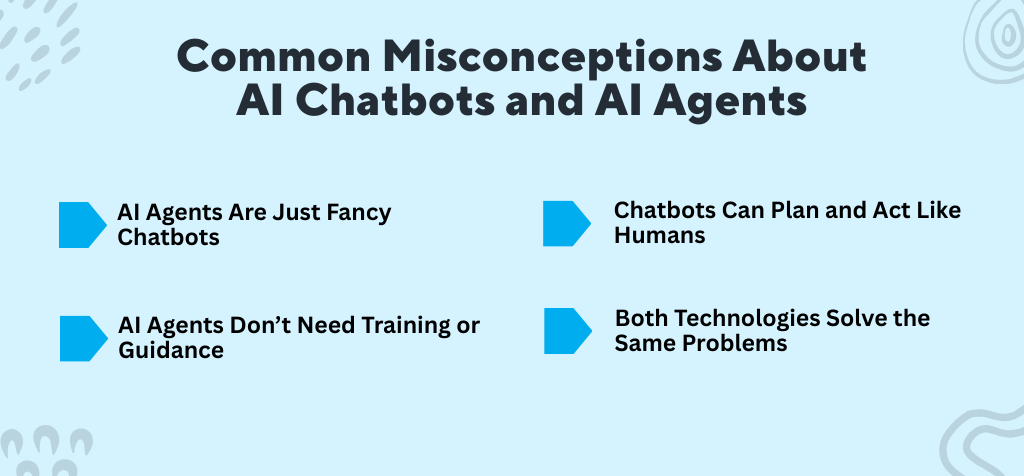
Many companies misinterpret what these technologies can and cannot accomplish as their adoption of artificial intelligence picks up speed. Understanding the distinction between AI agents and AI chatbots enables decision-makers to set reasonable expectations and avoid expensive automation errors.
Myth 1: “AI Agents Are Just Fancy Chatbots”
AI agents vary greatly from chatbots. Although chatbots center on conversation, AI agents are meant to plan, make judgments, and carry out multi-step activities without human intervention. This freedom separates AI agents from AI chatbots, in fact.
Myth 2: “Chatbots Can Plan and Act Like Humans”
Predefined logic, trained models, or conversational flows help chatbots react to user questions. Unlike AI agents, they do not autonomously arrange jobs, change techniques, or start processes.
Myth 3: “AI Agents Don’t Need Training or Guidance”
Irrespective of their autonomy, artificial intelligence agents need well-defined objectives, organized data, and constant optimization. Without constant refinement and monitoring, even sophisticated agents get irrelevant and inaccurate over time.
Myth 4: “Both Technologies Solve the Same Problems”
While AI agents manage difficult decisions and outcomes, AI chatbots are great at managing support questions and conversations. Mixing these duties frequently leads to inadequate automation and unfulfilled corporate goals.
Make the Right Decision for Your AI Development Company
The distinction between AI chatbots and AI agents is greatly simplified once the results, rather than the technology labels, are considered. This piece of writing can serve as a quick guide to help you connect your AI development services with the actual business needs.
If you want instant answers and conversations
Opt for an AI chatbot. It is perfect for managing FAQs, customer support questions, and interactions where user input triggers responses.
If you want systems that take initiative and complete tasks
Go for an AI agent. It is suitable for workflow automation, decision-making, and executing multi-step actions without being continually prompted.
If you want both intelligence and execution
“As businesses look toward the future, many forward-thinking companies are already combining the strengths of chatbot and AI agent technologies to deliver engaging user experiences while maintaining intelligent automation.
This approach reflects the direction AI solutions are heading in 2026, where organizations increasingly choose to hire AI app developers to build scalable systems that balance conversation, autonomy, and real-world execution.
Read More: Top 10 AI Development Companies
Final Thoughts
The future of intelligent automation is not a discussion of agent against chatbot. It is the deliberate blending of independence and communication. Though related, AI agents and chatbots have distinct objectives; one is good at engagement, the other at execution. They produce systems acting decisively as well as speak plainly when aligned properly.
Companies that grasp this equilibrium get efficiency, scalability, and long-run flexibility. We create AI ecosystems at Diginautical where chatbots and agents work flawlessly to support companies going beyond simple automation into really smart operations.
Frequently Asked Questions
Yes. With the right architecture, chatbots can evolve into AI agents by adding memory, decision logic, and autonomous workflows.
Most effective AI agents do, because real autonomy depends on integrations with tools, data sources, and operational platforms.
Yes, but only when combined with conversational layers. Pure agents work best behind the scenes, while chatbots handle direct interaction.
AI agents can evaluate outcomes, adjust decisions, and retry actions, whereas chatbots typically fail silently or escalate to humans.
Without monitoring and guardrails, yes. Well-designed AI agents require human-in-the-loop controls to ensure reliability and trust.